Last updated: 19 October 2026, around 13:00 Spanish time (CEST). This is a developing emergency and every figure below is preliminary. Rainfall data comes from Avamet and AEMET; casualty and response figures come from the Generalitat Valenciana, the Spanish government and news agencies.
Quick Answer
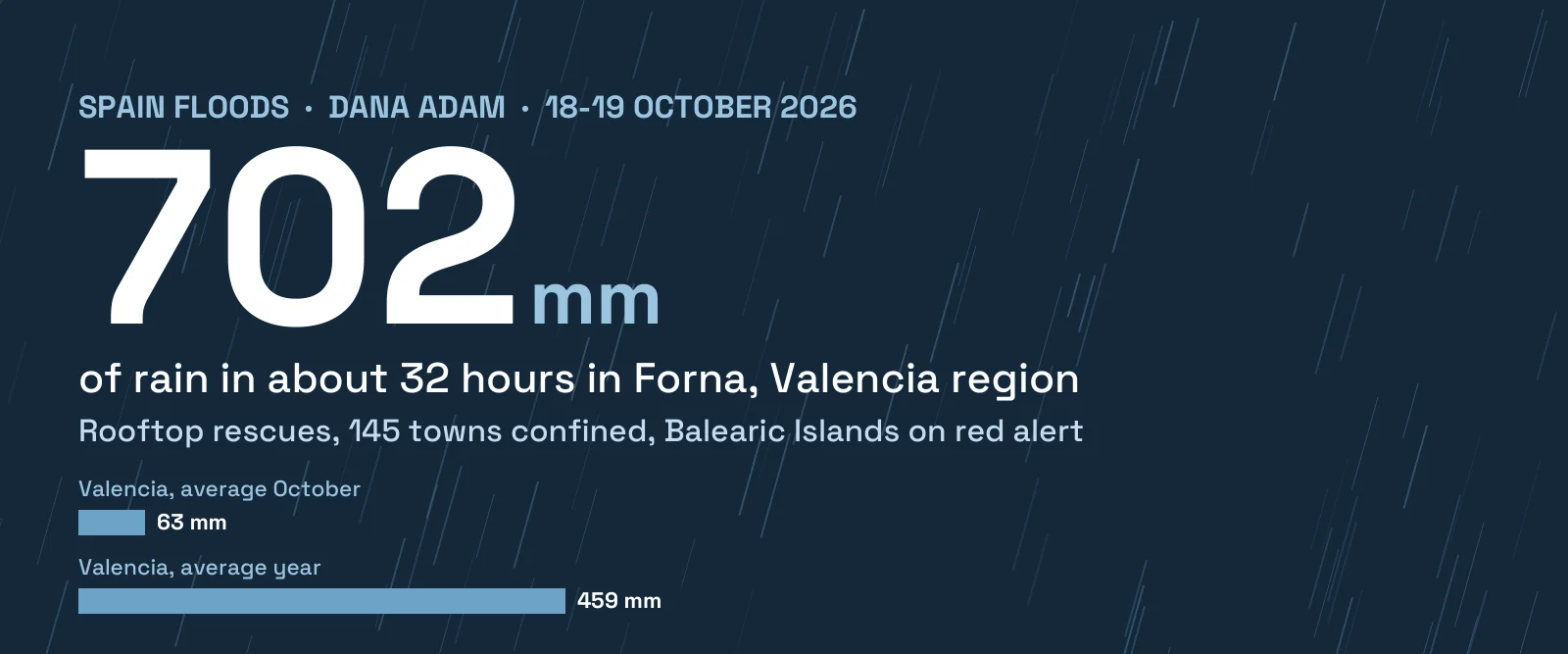
Spain is dealing with severe flooding from DANA Adam, a cut-off low-pressure system that brought torrential rain to Spain’s Mediterranean coast on 18 and 19 October 2026. Between Sunday and Monday morning, weather stations in the Valencian Community measured about 700 mm of rain in Forna (Alicante province), more than Valencia city gets in an average year. AEMET, Spain’s national weather agency, issued a red warning for the south coast of Valencia and the north of Alicante and said that, if confirmed, this is the biggest rain episode in the area since November 1987. At least two women have died, one in Catalonia and one in Sagunto. About 15 helicopters have been used for rescues, with people waiting on rooftops in Pego, and the military emergency unit (UME) has been sent to Oliva and Pego. The regional government ordered 145 municipalities to stay confined indoors, more than 102,000 students lost school days, and the Balearic Islands went on red emergency. AEMET expects the instability to ease from Tuesday 20 October.
Spain Floods at a Glance
| What | DANA Adam, the first named cut-off low (DANA) of the season, with torrential rain on Spain’s Mediterranean coast |
| When | Heaviest rain from Sunday 18 October to Monday 19 October 2026; easing from Tuesday 20 October |
| Most rain | Forna (l’Atzúbia, Alicante): 702 mm by 07:35 on Monday (Avamet), with other reports of up to 720 mm; Pego, Oliva, El Real de Gandia and Barx above 600 mm |
| Worst hit | La Safor (Gandia, Oliva) and La Marina Alta (Pego, Dénia, Xàbia), on the coast between Valencia and Alicante |
| Alerts | AEMET red warning on the south coast of Valencia and north of Alicante from 10:00 Sunday to 10:00 Monday; orange in several other regions; red emergency level in Mallorca, Ibiza and Formentera |
| Deaths | At least 2: a woman swept away by a stream at Cabrera de Mar (Barcelona) and a woman who disappeared in the sea off a beach in Sagunto (Valencia) and was found dead |
| Emergency calls | 781 incidents in the Valencian Community (400 in Valencia province, 381 in Alicante province); about 130 in the Balearic Islands |
| Response | 145 municipalities confined; about 15 rescue helicopters; UME deployed in Oliva, Pego and the Balearics; about 2,000 people evacuated from seven campsites in Oliva |
| Schools | More than 102,000 students off school in Valencia and Alicante provinces (80,913 + 21,868), plus Mallorca, Ibiza and Formentera |
| Transport | 17 roads cut (25 sections); Cercanías Valencia lines C1 and C2 suspended; Ibiza airport closed twice on Sunday; 64 cancellations at Ibiza and Palma on Sunday |
| Forecast | Rain moves north towards Catalonia on Monday; instability decreasing on Tuesday, with showers lingering in the northeast and the Balearics; maximum temperatures drop by more than 6°C in the east |
Where Did the Most Rain Fall?
The heaviest rain hit the inland valleys and coast of La Safor and La Marina Alta, two comarcas (counties) on the border of Valencia and Alicante provinces. Spanish agencies report rain in litres per square metre (l/m²). One l/m² is exactly one millimetre of rain, so 700 l/m² is 700 mm, or about 27.6 inches.
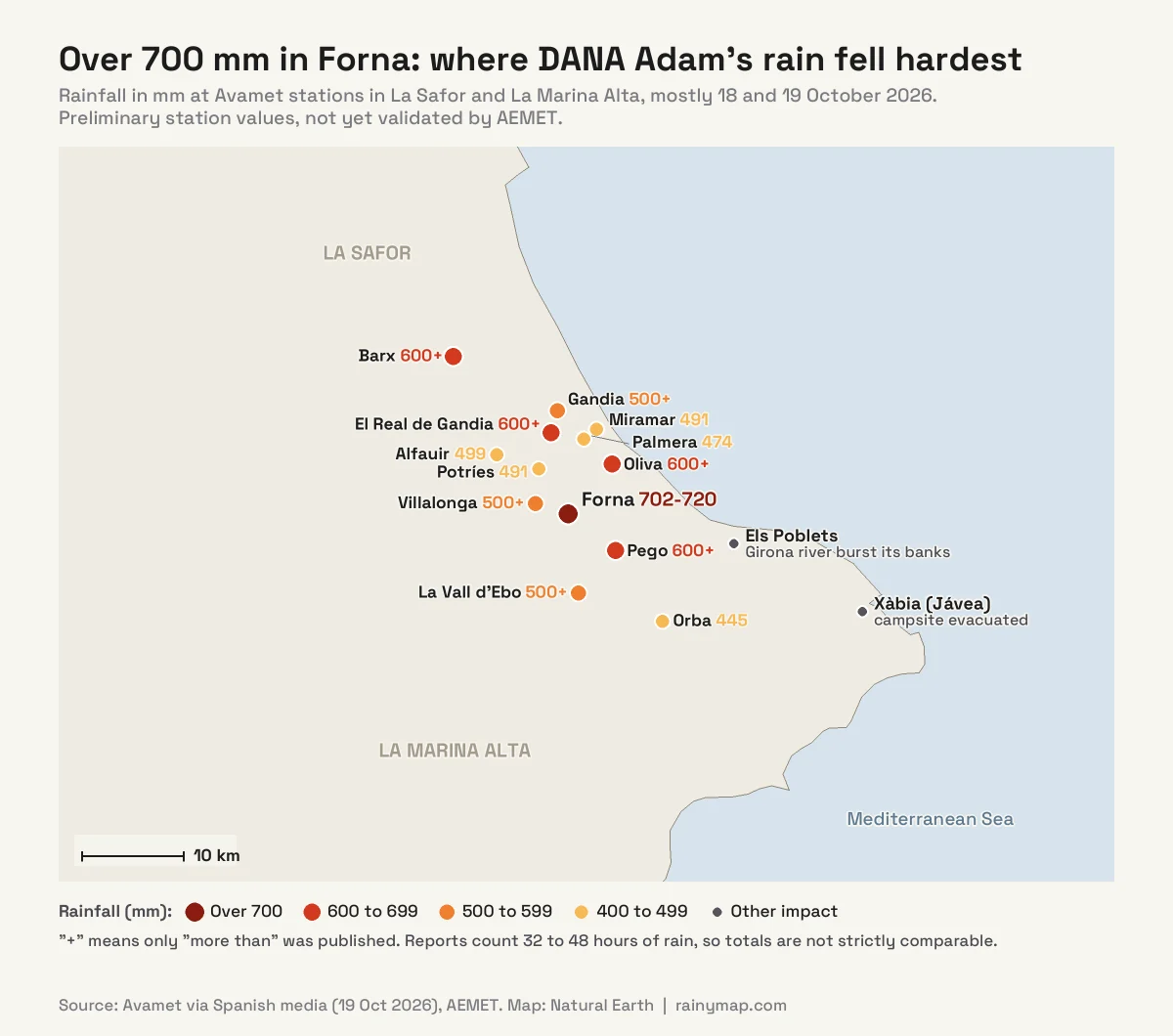
Avamet, the Valencian Meteorological Association’s station network, recorded 702 mm in Forna, a village in the municipality of l’Atzúbia, by 07:35 on Monday: 266 mm fell on Sunday and a further 436 mm between midnight and early Monday. Other reports give 714, 715 or 720 mm because they count different time windows. In a 24-hour snapshot published by EFE at 08:10 on Monday, Pego led with 638.5 mm and Forna had 635.2 mm, followed by Villalonga (559.3), La Vall d’Ebo (537.2), El Real de Gandia (518.8) and Barx (505.6). Pego, Oliva, El Real de Gandia and Barx all passed 600 mm, and Gandia, Villalonga and La Vall d’Ebo passed 500 mm. AEMET’s own measurements agree on the scale: more than 500 mm in 48 hours around Pego, El Real de Gandia, Villalonga and Barx, with some points above 600 mm, and 131.9 mm in a single hour at Oliva beach on Monday morning.
These are preliminary values from a weather-station network and are still to be checked. AEMET said that, if confirmed, this would be the largest rainfall episode in the area since November 1987.
How does it compare with Spain’s records?
Forna’s total is huge, but it is not (yet) a 24-hour national record, because it covers about 32 hours. The official 24-hour record for Spain is 817 mm at Oliva on 3 November 1987, measured in the same part of the Valencian coast; an AEMET climatologist notes that the gauge was emptied several times, so the true amount was probably higher. In October 2024, AEMET recorded 771 mm in 24 hours at Turís, including 185 mm in one hour, a Spanish one-hour record.
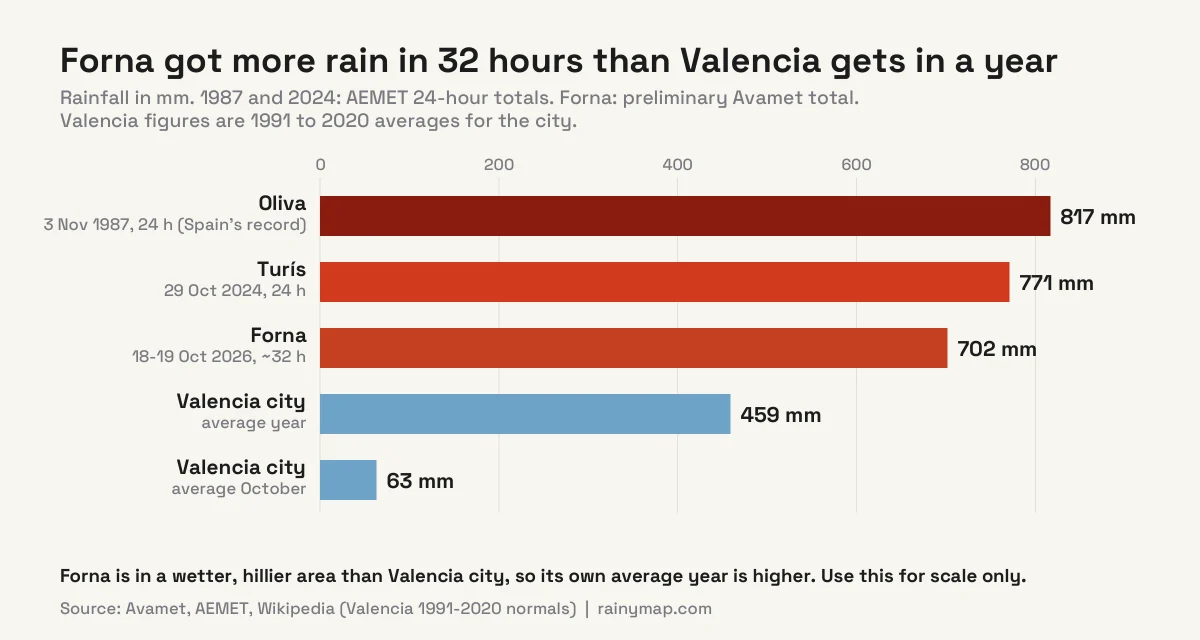
For scale, Valencia city averages 459 mm in a whole year and 63 mm in October, so Forna’s 702 mm in a day and a half is roughly 11 Octobers of rain. Our explainer on how much rain is a lot shows what these numbers mean on the ground.
What Has Happened on the Ground
Valencia and Alicante: rooftop rescues and confinement
The Generalitat Valenciana, the regional government, activated emergency situation 2 of its flood plan in La Safor and La Marina Alta and ordered the confinement of 145 municipalities on the south coast of Valencia and the north coast of Alicante. A phone alert (Es-Alert), the fourth of the episode, told residents to avoid all travel, stay indoors, move to upper floors, keep out of basements and garages and not use lifts. Emergency services handled 781 incidents between the two provinces.
The worst scenes were in Oliva and Pego. Government delegate Pilar Bernabé said about six municipalities between the south of Gandia and Oliva were cut off and “many people” were trapped. The mayor of Pego, Enrique Moll, said people were waiting on rooftops in the low-lying part of the town, in the Pego–Oliva marsh, for rescue by air, and access roads were cut. About 15 helicopters took part in rescues. The UME’s Third Intervention Battalion left its base at Bétera for Oliva, where the mayor, Yolanda Pastor, said around 2,000 people had been evacuated from seven campsites. In Xàbia (Jávea), more than 100 people were moved out of the El Naranjal campsite, and the Girona river burst its banks at Els Poblets, dragging cars along the streets.
Regional emergency minister Juan Carlos Valderrama said waves of more than four metres and strong winds were stopping rivers and ravines from draining into the sea, which made the flooding worse on the coast. Seventeen roads (25 sections) were cut, mostly in La Marina Alta, La Safor and La Ribera Alta, and Cercanías Valencia lines C1 and C2 were suspended. More than 102,000 students were off school: 80,913 in Valencia province and 21,868 in Alicante province.
Balearic Islands: red emergency in Mallorca, Ibiza and Formentera
The Balearic government declared its red emergency level for Mallorca, Ibiza and Formentera, and schools were closed on Monday. AEMET lowered the red rain warning to orange in the early hours of Monday. In the 24 hours to 08:00, Formentera recorded 123 mm and Ibiza airport 122 mm, with 97 mm at Sant Joan de Labritja. Ibiza airport suspended operations twice on Sunday (10:00 to 11:00 and 11:15 to 12:15) after water entered the terminal, and Ibiza and Palma airports together recorded 64 cancellations and 16 diversions that day. On Monday, Palma airport still had about 20 delayed flights, part of the road to Ibiza airport was closed, and Formentera hospital postponed scheduled surgery after rain damaged an area next to the operating theatre. Emergency services reported around 130 incidents in the islands, and the UME helped pump water out of garages in Ibiza.
Catalonia, Andalusia and the rest of Spain
In Catalonia, a woman was swept away by a stream at Cabrera de Mar, about 27 km north of Barcelona, on Saturday evening; her body was found in the sea. Early reports described a missing man, but Reuters and later reports identify a woman. In Andalusia, emergency services handled 155 incidents on Sunday morning, 121 of them in Almería, and an Es-Alert went out for the Poniente area and Almería city. Reuters reported a destroyed greenhouse in Almería and flooding in Algeciras (Cádiz). On Sunday, AEMET had orange warnings in Andalusia, the Balearics, Castilla-La Mancha, Catalonia and Murcia, with yellow warnings in Galicia, Ceuta and Melilla, and seven regions plus Ceuta and Melilla were under warnings because of Adam.
Deaths
Two deaths are confirmed in this episode. The first is the woman at Cabrera de Mar. The second is a woman who disappeared in rough seas off a beach in Sagunto, Valencia province, and whose body was later found. Reports differ on the beach (Corinto or Almardà) and on whether she was bathing with her partner or surfing. None of the reports we reviewed mentioned deaths in the flooded towns of La Safor and La Marina Alta, but rescues were still under way and the toll may change.
A Fortnight of Floods in Spain
Adam is the latest in a run of floods this month. Reuters counted five deaths from heavy rain and flooding in Spain in the 15 days to 18 October.
| Date | Place | What happened |
|---|---|---|
| 2 October | Madrigueras, Albacete | More than 140 mm in about two hours; a 102-year-old woman died, about 90 people were rescued and four homes collapsed |
| 3 to 4 October | Barcelona and Girona, Catalonia | Red alert on Saturday 3 October; two people dead and one missing; firefighters answered more than 1,500 calls |
| 17 October | Cabrera de Mar, Barcelona | Woman, 35, swept away by a stream; body found in the sea |
| 18 to 19 October | Valencia, Alicante, Balearic Islands | DANA Adam: over 700 mm in La Safor and La Marina Alta, rooftop rescues, 145 municipalities confined, red emergency in the Balearics |
The timing adds weight to the story: 29 October is the second anniversary of the 2024 DANA that killed more than 220 people in the province of Valencia alone (national totals are usually given as roughly 230 to 240). Our report on the Istanbul floods earlier this month and our look at why flash flooding keeps breaking records show the same pattern elsewhere.
What Is a DANA, and Why Is Adam So Intense?
DANA stands for “Depresión Aislada en Niveles Altos”, an isolated low-pressure system in the middle and upper atmosphere. It is also known in Spain as a “gota fría” (cold drop). A DANA breaks away from the main jet stream and can sit almost still for days, so the same area keeps getting rain. Since October 2025, AEMET names a DANA when it expects orange or red warnings (the first was Alice that month), and Adam is the first named DANA of this autumn.
- Moist onshore wind. AEMET said a strong northeasterly flow at low levels, loaded with Mediterranean moisture and driven by high pressure over the British Isles, pushed wet air against the coast. Check the live wind map to see how coastal wind direction shapes rain.
- Hills behind the coast. Mountains close to the shore force moist air upwards, which tends to concentrate rain in the same valleys.
- Warm sea. Jorge Olcina, a professor of climatology at the University of Alicante, linked the intensity to about 50 years of Mediterranean warming and said such episodes have become a lasting feature of the region’s climate.
- Short, steep watercourses. Ramblas and barrancos, normally dry ravines, can turn into torrents within minutes, and rough seas stop them draining.
Forecast: When Will the Rain Stop?
AEMET expects the heaviest rain to ease on the Valencian coast on Monday and shift towards Catalonia, where strong or very strong persistent showers are forecast and AEMET had orange warnings for Barcelona, Girona and Tarragona. Storms are also expected in Andalusia, Ceuta and Melilla. On Tuesday 20 October the instability should decrease as the DANA is absorbed into the general circulation, with showers staying in the far northeast and the Balearics. A mass of colder air will cut maximum temperatures by more than 6°C across the eastern half of the peninsula, with light frost in the northern mountains.
Flooding does not stop when the rain does. Rivers and ravines can keep rising for hours after a downpour, mud and debris block roads, and saturated slopes can fail. Follow the official AEMET warnings map and our 7-day forecast for updates.
Travel: Flights, Trains and Roads
- Flights. Check your airline and Aena’s flight information before leaving for Ibiza, Palma, Valencia or Alicante airports. Knock-on delays are likely even where runways are open, and keep receipts for reasonable expenses if your trip is disrupted.
- Trains. Cercanías Valencia lines C1 and C2 were suspended on Monday morning. We found no report of long-distance line closures, but check Renfe before travelling.
- Roads. 17 roads were cut in Valencia and Alicante provinces, and access to Pego and Oliva was blocked. In the confined municipalities, officials ask everyone to avoid all travel.
- Beaches and campsites. Seven campsites near Oliva and one in Xàbia were evacuated, and rough seas with waves above four metres make the coast dangerous.
How to Stay Safe in a Flood in Spain
- Follow the Es-Alert and local orders. Stay indoors if you are in a confined municipality and go to an upper floor if water enters the building.
- Keep out of basements, garages and underground car parks. They fill within minutes. Do not go down to move a car, and do not use lifts.
- Stay away from rivers, ravines and dry riverbeds. They can rise in minutes, even if it is no longer raining where you are.
- Never walk or drive through floodwater. Fast, shallow water can sweep away a person or a car.
- Call 112 for an emergency and follow instructions from the regional emergency service. Our flash flood safety guide has a checklist for before, during and after a flood, and our guide to flash flood warning signs on radar explains how to spot the storms that cause them.
Spanish Words You Will See in the News
| DANA / gota fría | Isolated upper-level low (cut-off low); “gota fría” is the older popular name |
| Aviso rojo / naranja / amarillo | AEMET red, orange and yellow weather warnings |
| Confinamiento | Order to stay indoors and avoid travel |
| Es-Alert | Public warning sent to every mobile phone in an area |
| Barranco, rambla, riera | Ravine or dry stream bed that fills suddenly in heavy rain (riera is the Catalan term) |
| Desbordamiento | A river or stream overflowing its banks |
| l/m² (litros por metro cuadrado) | Litres per square metre; 1 l/m² equals 1 mm of rain |
| UME | Unidad Militar de Emergencias, Spain’s military emergency unit |
| Generalitat | The regional government of the Valencian Community (and of Catalonia) |
| Avamet | Associació Valenciana de Meteorologia, a network of weather stations |
Follow the Rain Live
RainyMap’s Spain radar page, the Valencian Community radar and the Catalonia radar show where rain is falling right now, as does the global live rain map. Use the live lightning map to see where storms are active, Rainfall Check to look at any location, or see where it is raining right now around the world. Radar shows what has fallen and where it is heading, but for evacuation or travel decisions follow AEMET, the Generalitat Valenciana and the 112 emergency service.
Frequently Asked Questions
Where are the floods in Spain right now?
The worst flooding is on the Mediterranean coast between Valencia and Alicante, especially in La Safor (Gandia, Oliva) and La Marina Alta (Pego, Dénia, Xàbia). The Balearic Islands (Mallorca, Ibiza, Formentera) were also hit, and Catalonia and Andalusia have had flooding and storms.
How much rain has fallen in Valencia and Alicante?
Avamet recorded 702 mm in Forna (Alicante province) by 07:35 on Monday 19 October, with other reports of up to 720 mm. Pego, Oliva, El Real de Gandia and Barx passed 600 mm. Valencia city averages 459 mm in a whole year, so Forna received more in about a day and a half.
Is this the worst flooding in Spain’s history?
No. The 2024 DANA killed more than 220 people in the province of Valencia, and Spain’s 24-hour rainfall record is 817 mm at Oliva in November 1987. AEMET said that, if confirmed, Adam is the largest rain episode in this area since 1987, but the death toll so far is far lower than in 2024.
How many people have died in the Spain floods?
At least two women have died in DANA Adam: one swept away by a stream at Cabrera de Mar (Barcelona) and one who disappeared in the sea off a beach in Sagunto (Valencia) and was found dead. Reuters counted five flood-related deaths in Spain over the 15 days to 18 October. Rescues were continuing, so the figures may change.
What is DANA Adam?
DANA Adam is the name AEMET gave to a cut-off low-pressure system that brought torrential rain to eastern Spain on 18 and 19 October 2026. AEMET names a DANA when it expects orange or red warnings; Adam is the first named DANA of this autumn.
What does DANA mean?
DANA stands for “Depresión Aislada en Niveles Altos” (isolated depression at high levels). It is a pool of cold air high in the atmosphere that separates from the jet stream and can stall for days, which can trigger repeated heavy storms. It is also called a “gota fría”.
Is the Valencia region in lockdown?
The Generalitat Valenciana ordered 145 municipalities on the south coast of Valencia and the north coast of Alicante to stay confined. People were told to stay indoors, avoid all travel, move to upper floors and keep out of basements and garages. It is a flood-safety measure, not a general lockdown.
Is it safe to travel to Valencia, Alicante, Ibiza or Mallorca?
Not to the worst-hit coast right now. Roads around Oliva, Pego and Gandia are cut and residents are asked not to travel. In the Balearics, red alerts were lowered to orange on Monday but flights are delayed. Check your airline, Aena, Renfe and local official channels before you leave.
Are flights to Ibiza and Palma affected?
Yes. Ibiza airport suspended operations twice on Sunday after water entered the terminal, and Ibiza and Palma airports had 64 cancellations and 16 diversions that day. Palma still had about 20 delayed flights on Monday morning.
When will the rain stop in Spain?
AEMET expects the rain to ease on Monday on the Valencian coast and move towards Catalonia, with instability decreasing on Tuesday 20 October. Showers may linger in the far northeast and the Balearics. Rivers and ravines can still be dangerous for hours after the rain stops.
Why does eastern Spain flood so often in autumn?
In autumn the Mediterranean Sea is still warm, and a cold DANA overhead can combine with moist onshore winds to produce very heavy rain. Steep hills close to the coast and short, dry ravines that fill in minutes make flash floods more likely.
What should I do if I am caught in a flood in Spain?
Move to higher ground or an upper floor, stay out of basements, garages and floodwater, and call 112. Follow the Es-Alert and instructions from local authorities.
How can I follow the floods live?
Use RainyMap’s live radar for Spain and the Valencian Community to watch rain in real time, and follow AEMET’s warnings page and the 112 service of the Generalitat Valenciana for official updates.
Sources
- Euro Weekly News: Travel chaos, historic floods hit Valencia (19 Oct)
- Euro Weekly News: 2,000 evacuated as floods force helicopter rescues (19 Oct)
- Euronews (Spanish): La DANA Adam mantiene en alerta a la Comunidad Valenciana y Baleares
- Infobae / EFE: La dana Adam deja 2 muertos y la Comunidad Valenciana confina 145 municipios
- Infobae: Peligro extremo por lluvias en Valencia y Alicante, aviso rojo de la Aemet
- Última Hora: La dana Adam, en directo (Balearic and Valencian updates)
- El Periódico de Aquí: Los pueblos que más lluvia han registrado por la dana Adam (Avamet)
- TodoAlicante: Caos en el norte de Alicante por lluvias torrenciales históricas
- Castellón Diario: Los rescates se multiplican por las inundaciones de la dana Adam
- The Olive Press: Severe floods hit Valencia, people warned not to travel
- Majorca Daily Bulletin: Storm Adam has left two people dead in Spain
- Reuters via RTÉ: Woman dies as torrential rain sparks floods in Spain
- The Watchers: Flash flooding in Madrigueras, Spain (2 Oct)
- Euronews: Floods leave streets and roads submerged across Catalonia (5 Oct)
- AEMET: Naming of DANAs (in Spanish)
- AEMET blog: The Safor flood of 3 November 1987, Spain’s wettest 24 hours (in Spanish)
- AEMET: October 2024 climate summary (Turís, 29 October 2024)
- Wikipedia: 2024 Spanish floods
- Wikipedia: Climate of Valencia (1991 to 2020 normals)