
Last updated: 15 October 2026. Rainfall figures from AKOM, the Istanbul Metropolitan Municipality’s disaster coordination centre; damage and casualty figures from the Istanbul Governor’s Office and news agencies. Numbers are preliminary and are still being updated.
Quick Answer
Istanbul was hit by its heaviest rain in decades on 13–15 October 2026. The Istanbul Metropolitan Municipality said some areas received the most rain since 1985. AKOM’s 30 stations recorded up to 269.5 mm in Beykoz between midnight on 13 October and 07:30 on 15 October, about 56 hours. That is almost three times the 98 mm Istanbul normally gets in a whole October. At least two people died: a 14-year-old boy electrocuted after stepping into a puddle in Balat, and a 34-year-old man who fell on a flooded road in Sarıyer. The Governor’s Office counted 1,277 floods, 15 landslides and 47 people stranded on Wednesday alone, while the municipality received 6,937 emergency reports. Roads collapsed, floodwater entered two hospitals, and 43 aircraft were diverted from Istanbul Airport. Schools in six provinces were closed on Thursday and motorcycles were banned from Istanbul’s roads. The Governor’s Office expects rain to continue into Thursday afternoon, with showers on Friday and into Saturday.
Istanbul Floods at a Glance
| When | Rain began on the evening of Tuesday 13 October; heaviest on Wednesday 14 October; continuing on Thursday 15 October |
| Most rain (AKOM) | Beykoz 269.5 mm, Sarıyer 206.1 mm, Eyüpsultan 202.2 mm (13 Oct 00:00 to 15 Oct 07:30) |
| Compared with normal | Average October rainfall is about 98 mm; Beykoz received almost 2.7 times that |
| Deaths | At least 2 (Fatih and Sarıyer districts) |
| Incidents | 6,937 emergency reports (municipality); 1,277 floods, 15 landslides, 47 people stranded on Wednesday (Governor’s Office) |
| Affected | More than 800 homes, 280 businesses and 76 vehicles (early count) |
| Flights | 43 aircraft diverted from Istanbul Airport; Sabiha Gökçen briefly halted, resumed 10:02 pm Wednesday |
| Closures | Schools shut on 15 Oct in Istanbul, Düzce, Zonguldak, Sakarya, Kocaeli and Yalova; motorcycle ban in Istanbul from 9 pm Wednesday |
| Response | More than 8,000 personnel and about 2,000 vehicles and machines deployed |
How Much Rain Fell?
Turkish authorities report rainfall in kilograms per square metre. One kg/m² equals one millimetre of rain, so 269.5 kg/m² is 269.5 mm, or 10.6 inches. AKOM’s table for the 56 hours from midnight on 13 October to 07:30 on 15 October shows the heaviest rain fell in the northern districts and along the Bosphorus:
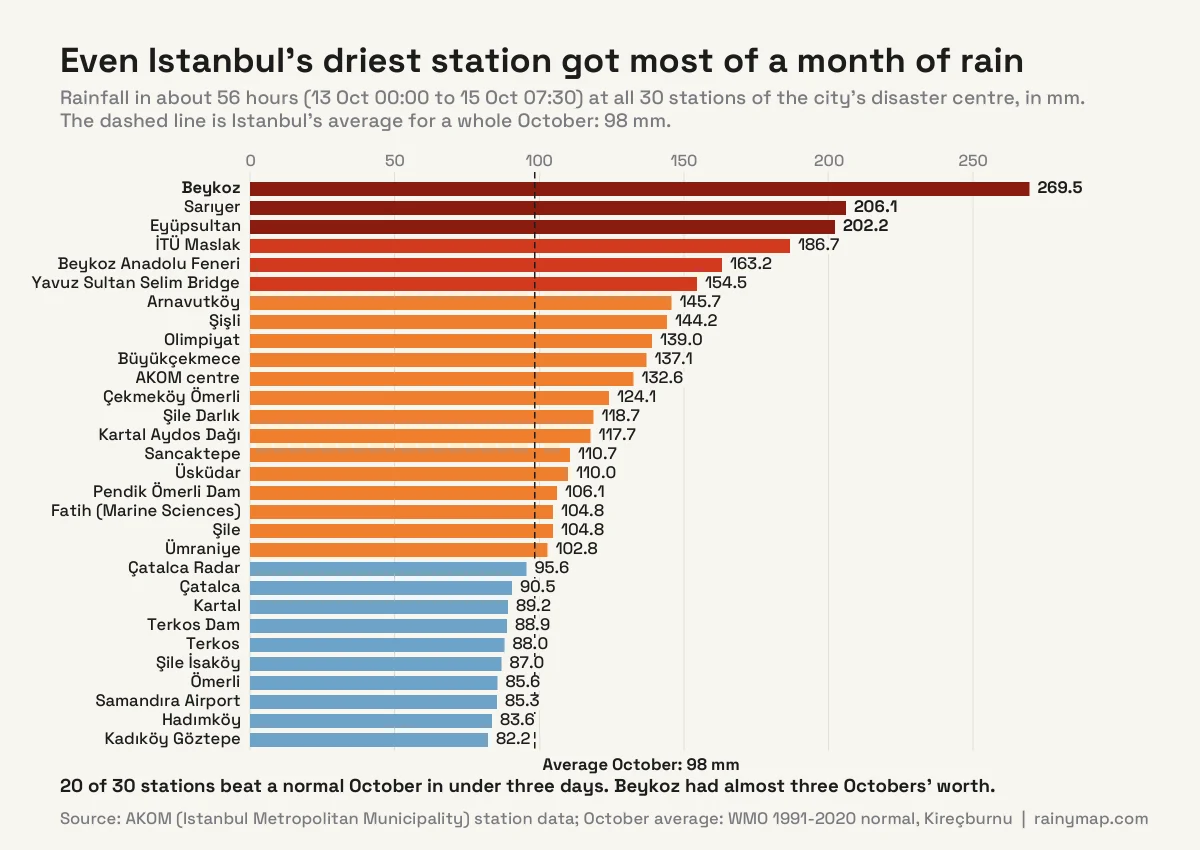
Three districts passed 200 mm: Beykoz (269.5 mm), Sarıyer (206.1) and Eyüpsultan (202.2). The driest of the 30 stations, Kadıköy Göztepe on the Asian shore of the Marmara Sea, still recorded 82.2 mm, which is 84% of an average October. Figures differed between early reports because each used a different time window and station. The Governor’s Office reported 193.84 mm at Ömerli in Beykoz on 14 October, early news reports quoted 242 mm for Beykoz, and AKOM’s later total was 269.5 mm. Acting mayor Nuri Aslan said that parts of the city received nearly 100 mm in just 12 hours.
How unusual is that?
Istanbul’s average October rainfall is 98.3 mm at Kireçburnu in Sarıyer (WMO 1991–2020 normal), spread over about 12 rainy days. Beykoz’s total is 2.7 times that. It is also more than the average for any month of the year: the wettest, December, averages 125 mm, and the whole year averages 865 mm. In other words, about 31% of a year’s rain fell in Beykoz in two and a half days.
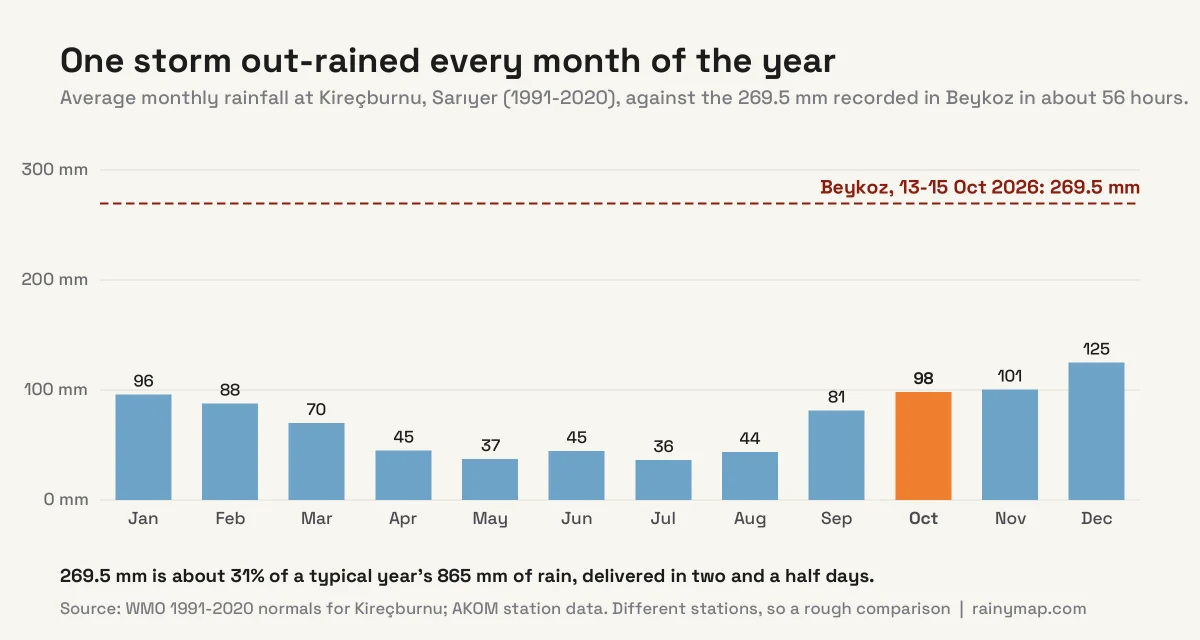
The city’s own comparison is with 1985: the Istanbul Metropolitan Municipality said some areas recorded the highest amount of rain since then. That statement has not been backed by a published record table, so treat “since 1985” as the municipality’s claim rather than a verified record. For context, a downpour in September 2023 dropped about 125 kg/m² in under six hours. An earlier major flood, in September 2009, killed at least 31 people; NASA described it as the heaviest rain in 80 years at the time, with about 200 mm in a week along the coast.
What Happened in the City
Deaths
Two deaths have been confirmed. A 14-year-old boy was electrocuted after stepping into a puddle in Çukurbostan Park in Balat, Fatih district; authorities have not yet said where the current came from, and an investigation is under way. A 34-year-old man died in hospital in Sarıyer after losing his balance on a flooded road and hitting his head on a curb. Rescuers saved hundreds of people stranded at their workplaces overnight, and a woman swept down a street in Esenyurt was pulled to safety by passers-by.
Floods, landslides and collapsed roads
On Wednesday alone, the Governor’s Office recorded 1,277 floods and 15 landslides, and 47 people were stranded. The municipality’s total of emergency calls reached 6,937. Roads buckled in Eyüpsultan, where the street in front of the district municipality building collapsed, and in Gaziosmanpaşa. Floodwater entered two hospitals: Şişli Hamidiye Etfal in Sarıyer and Mimar Sinan State Hospital in Büyükçekmece. Water poured from the ceiling of Hacıosman metro station. A retaining wall collapsed at a primary school in Sultangazi while students were inside, though no injuries were reported. Early counts show more than 800 homes, 280 businesses and 76 vehicles affected.
Transport
Traffic reached about 90% density at the evening rush hour, and some tram and metro lines were disrupted before service resumed on Thursday morning. At Istanbul Airport, 43 aircraft that could not land were diverted, 39 to other Turkish airports and 4 abroad, according to the Ministry of Transport. Sabiha Gökçen Airport briefly halted operations because of strong winds and wind shear and resumed at 10:02 pm on Wednesday. Some reports said flights were otherwise operating normally, so check with your airline before travelling.
Closures and restrictions
Governor Davut Gül asked residents to stay home on Thursday unless travel was essential, and to avoid creek beds and underpasses. People in basement flats were asked to spend the night on higher floors, or call 112 if they had nowhere safe to go. Schools were closed on 15 October in six provinces: Istanbul, Düzce, Zonguldak, Sakarya, Kocaeli and Yalova. Motorcycles and scooters were banned from Istanbul’s roads from 9 pm on Wednesday until further notice, and several universities moved classes online. About 8,000 personnel and 2,000 vehicles and machines were deployed in the city of about 16 million people.
Why Istanbul Floods So Easily
The reports we reviewed do not name the weather system behind this event, so we will not guess at it. Istanbul’s flood risk comes from a combination of local factors that make any heavy downpour dangerous:
- The Black Sea. Autumn is the season when cold air arriving from the north can pass over still-warm Black Sea water and produce persistent, heavy showers on Istanbul’s northern shore. The Governor’s Office forecast northerly winds with gusts of 60 to 80 km/h.
- Hills and valleys. The northern districts such as Beykoz, Sarıyer and Eyüpsultan sit on steep, forested slopes. Rain runs quickly down to streams that now flow beneath dense neighbourhoods.
- Concrete. Paved surfaces stop rain soaking in, so storm drains overflow within minutes. That is why underpasses, basements and low-lying roads are the first places to flood.
- Saturated ground. After a day or more of rain, soil cannot absorb any more, which is when landslides and road collapses become likely.
Our guide to flash flood warning signs on radar explains how to spot this kind of storm building, and our explainer on how much rain is a lot helps put millimetre figures in context. For scale, 270 mm in two and a half days is nearly three times the rain Istanbul normally gets in a whole month.
What Happens Next
According to the Istanbul Governor’s Office, rain is expected to continue until Thursday afternoon, followed by intermittent showers on Friday and into Saturday afternoon. Temperatures should run 4 to 6°C below the seasonal norm, with northerly winds of 40 to 60 km/h and gusts of 60 to 80 km/h. AKOM forecast an additional 50 to 75 mm in some districts by 10:00 on Thursday, mainly on the Asian side and around the Bosphorus. The Interior Ministry warned of sudden floods in several provinces on Wednesday and Thursday. The ground is saturated, so even moderate rain over the next days can cause new floods or landslides. Follow the Governor’s Office and AKOM for updates.
How to Stay Safe in a City Flood
- Stay out of floodwater. It can hide open manholes, and it can carry electricity. A 14-year-old died this week after stepping into a puddle. Keep away from street lights, electrical boxes and fallen cables.
- Avoid underpasses and basements. They fill in minutes. If you live in a basement flat, move to an upper floor when heavy rain is forecast.
- Do not drive through flooded roads. Even shallow, fast water can sweep a car away; the Istanbul floods carried parked cars down streets.
- Stay away from streams and steep slopes. Landslides can follow heavy rain by hours or days.
- Call 112 in an emergency and follow official instructions. Our flash flood safety guide has a full checklist for before, during and after a flood.
Follow the Rain Live
RainyMap’s Türkiye radar page and the global live rain map show where rain is falling right now. You can also use Rainfall Check to look at any location, or see where it is raining right now around the world. Radar shows what has fallen and where it is heading, but for evacuation or travel decisions follow the Governor’s Office, AKOM and the Turkish State Meteorological Service.
Frequently Asked Questions
How much rain fell in Istanbul in October 2026?
AKOM, the Istanbul Metropolitan Municipality’s disaster centre, recorded up to 269.5 mm (269.5 kg/m²) in Beykoz between midnight on 13 October and 07:30 on 15 October. Sarıyer received 206.1 mm and Eyüpsultan 202.2 mm. The average for a whole October is about 98 mm.
Is this the worst flood in Istanbul’s history?
Not necessarily. The municipality said some areas had the most rain since 1985, but no published record table confirms it, and deadlier floods have happened: the September 2009 floods killed at least 31 people. The 2026 floods have killed at least two so far.
How many people died in the Istanbul floods?
At least two: a 14-year-old boy electrocuted in a park in Balat, Fatih district, and a 34-year-old man who died after falling on a flooded road in Sarıyer. These are the figures reported as of 15 October.
Which parts of Istanbul were hit hardest?
The most rain fell in Beykoz, Sarıyer and Eyüpsultan, each above 200 mm. Roads collapsed in Eyüpsultan and Gaziosmanpaşa, and floodwater entered hospitals in Sarıyer and Büyükçekmece.
Are flights to Istanbul affected?
On Wednesday, 43 aircraft were diverted from Istanbul Airport and Sabiha Gökçen Airport briefly halted operations because of strong winds. Operations resumed at 10:02 pm. Check your airline’s status before heading to the airport, because more rain and wind are forecast.
Are schools open in Istanbul?
No. Schools were closed on Thursday 15 October in Istanbul and five other provinces: Düzce, Zonguldak, Sakarya, Kocaeli and Yalova. Several Istanbul universities moved classes online.
What is the forecast for Istanbul?
The Governor’s Office expects rain until Thursday afternoon and intermittent showers on Friday and into Saturday afternoon, with temperatures 4 to 6°C below normal and gusts of 60 to 80 km/h. The ground is saturated, so further flooding and landslides are possible.
What does kg/m² mean in a rainfall report?
One kilogram of water spread over one square metre is exactly one millimetre deep, so 1 kg/m² equals 1 mm of rain. Turkish agencies use kg/m², while most other countries report millimetres.
Is it safe to travel to Istanbul now?
Istanbul’s airports are operating, but there are weather disruptions, a motorcycle ban and flooded roads and underpasses. If you are there, follow the Governor’s Office advice to stay indoors unless travel is necessary, and avoid underpasses and basement-level rooms until the rain stops.
Why do heavy rains cause so much flooding in Istanbul?
Istanbul is a city of about 16 million people built on steep hills, with many streams now buried under roads and concrete. Heavy downpours overwhelm drains within minutes, flooding underpasses and basements, and saturated slopes can give way in landslides.
Sources
- Karar: AKOM rainfall data by station, 13–15 October (in Turkish)
- Al Jazeera: Teenager dies as heavy rain floods Istanbul
- Euronews: At least two killed after heavy rain and widespread flooding
- Türkiye Today: Istanbul floods kill 2 as 43 flights diverted, schools close
- Türkiye Today: Istanbul roads collapse, traffic hits 90% as flooding continues
- Associated Press via ABC News: Heavy rain shuts down Istanbul
- US News: Heavy rain and flooding in Istanbul forces closure of schools
- Wikipedia: Climate of Istanbul (WMO 1991–2020 normals for Kireçburnu)
- NASA Earth Observatory: Heavy Rain in Istanbul (September 2009 floods)