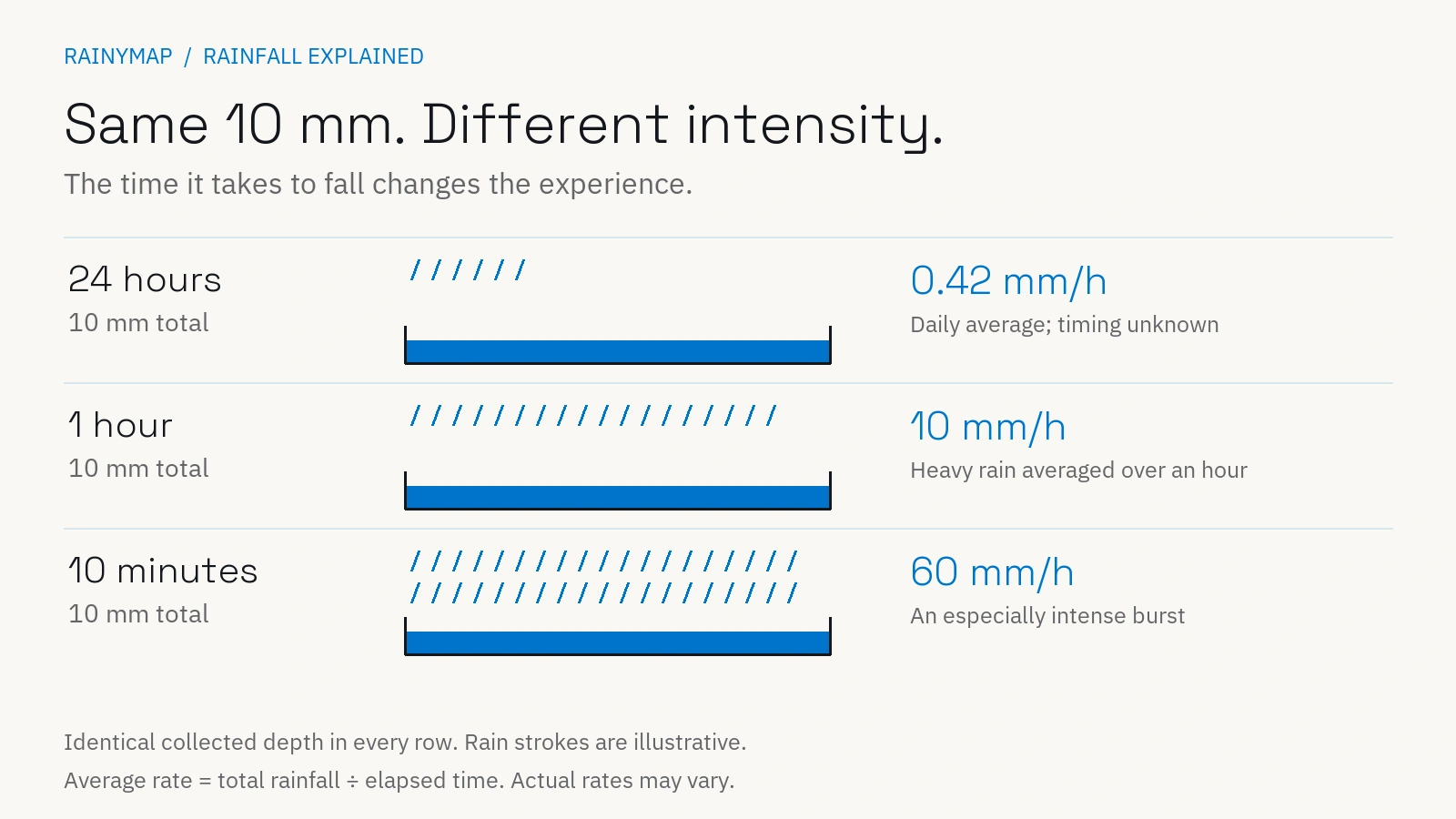
Ten millimetres of rain is a noticeable amount, but how quickly it falls matters most. Spread over 24 hours, it does not necessarily mean heavy rain or an all-day washout. Falling in one hour, 10 mm is heavy rainfall. It equals 10 litres of water per square metre, or about 0.39 inches.
Before changing your plans, check whether the forecast means 10 mm today, 10 mm in an hour, or a rainfall rate of 10 mm/h. Those figures can describe very different conditions.
| 10 mm falls over… | Average rate | How to interpret it |
|---|---|---|
| 24 hours | 0.42 mm/h | The daily total alone does not reveal when or how heavily it rains. |
| 6 hours | 1.67 mm/h | Could accumulate through prolonged lighter rain, with heavier bursts possible. |
| 1 hour | 10 mm/h | Heavy rainfall averaged across the hour. |
| 30 minutes | 20 mm/h | A concentrated downpour. |
| 10 minutes | 60 mm/h | An especially intense burst, despite the same total. |
Calculated averages: total rainfall divided by elapsed time. Actual intensity can vary throughout each period.
For your local outlook, check the hourly weather forecast. If rain is already nearby, use the live rain map to follow its recent movement.
What does 10 mm of rain actually mean?
Rainfall in millimetres describes the depth of water that would collect on a level surface if none soaked into the ground, ran away, or evaporated.
A measurement of 10 mm means a water layer 1 centimetre deep under those conditions. It does not mean every puddle will be 1 centimetre deep: water flows into low spots, drains away, and soaks into permeable ground.
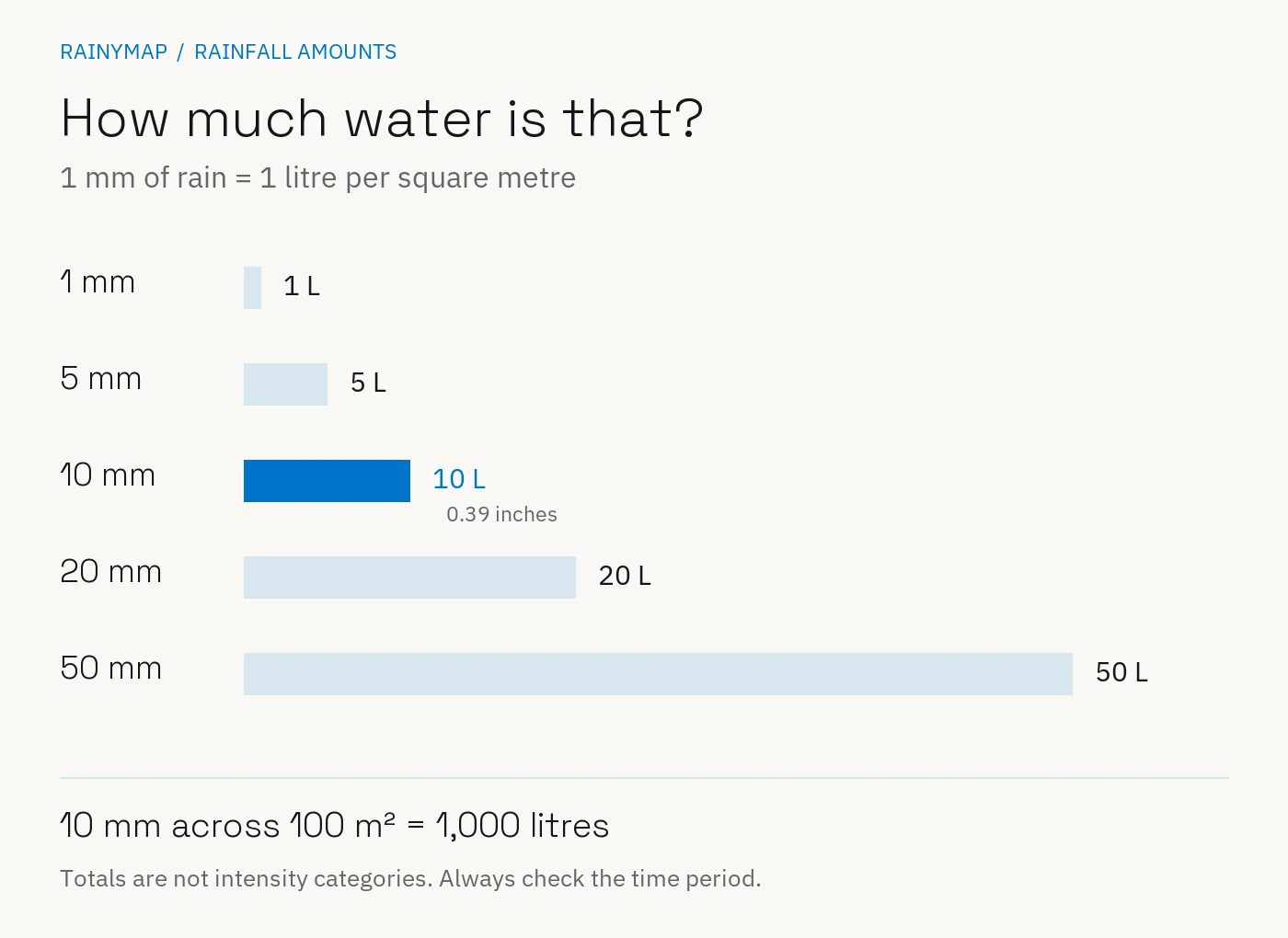
The useful conversion is 1 mm of rain = 1 litre of water per square metre. The Australian Bureau of Meteorology explains this relationship in its rainfall calculation guidance.
Using that conversion, 10 mm falling uniformly across a 100-square-metre area delivers 1,000 litres of water. The depth sounds small; the volume across a roof, garden, or street is substantial.
Is 10 mm of rain in a day a lot?
Ten millimetres in a day is a meaningful amount of rain, but it does not tell you whether the whole day will be wet. It could arrive overnight, fall intermittently, or accumulate in one short shower.
Consider three hypothetical days, each with a total of 10 mm:
- Day A: Rain falls overnight and clears before breakfast.
- Day B: Light rain continues for much of the day.
- Day C: A heavy afternoon shower delivers the entire amount in 30 minutes.
The daily rainfall total is identical. The effect on a lunchtime walk or outdoor event is not.
Dividing 10 mm by 24 hours gives an average of approximately 0.42 mm per hour. However, that calculation does not establish that light rain fell continuously. A daily average can hide a brief downpour.
Whether 10 mm is unusual also depends on the local climate and season. To judge how exceptional an event is, compare it with local rainfall records for the same duration.
Is 10 mm of rain in an hour heavy?
Yes. Ten millimetres falling within one hour qualifies as heavy rainfall under both the WMO criteria cited below and the US National Weather Service’s ASOS intensity thresholds.
A World Meteorological Organization guide places rain at 10 to less than 50 mm/h in its heavy category. See the WMO precipitation-intensity criteria, hosted by the National Weather Service.
The National Weather Service’s ASOS documentation uses a different boundary: heavy rain is above 0.30 inches per hour, approximately 7.6 mm/h. See the NWS rain-intensity documentation.
Labels such as “moderate” and “heavy” are not completely uniform across organisations and products. The clearest description is the measured amount and period: 10 mm in one hour.
An hour that collects 10 mm might contain a few minutes of much heavier rain followed by lighter rain or a dry interval. Its average does not reveal its peak intensity.
How much rain is 1, 5, 10, 20, or 50 mm?
The comparison below shows accumulated amounts. These are conversions, not official intensity categories: a total cannot be classified properly without knowing its duration.
| Rainfall total | Inches (approx.) | Water per m² |
|---|---|---|
| 1 mm | 0.04 in | 1 litre |
| 2 mm | 0.08 in | 2 litres |
| 5 mm | 0.20 in | 5 litres |
| 10 mm | 0.39 in | 10 litres |
| 20 mm | 0.79 in | 20 litres |
| 25.4 mm | 1.00 in | 25.4 litres |
| 50 mm | 1.97 in | 50 litres |
Inch conversions use 25.4 mm = 1 inch and are rounded to two decimal places.
Five millimetres falling over several hours and 5 mm falling in five minutes are very different experiences. Likewise, 50 mm spread across a month says little about any particular day. Always read rainfall amounts with their time period attached.
What is the difference between mm and mm/h?
Millimetres measure accumulated rainfall. Millimetres per hour measure how quickly rain is falling. Think of filling a container: the depth already collected is the amount; the speed at which water is being added is the rate.
For a constant rainfall rate: rainfall amount = rainfall rate × duration in hours.
- Rain at 10 mm/h for 15 minutes produces 2.5 mm.
- Rain at 10 mm/h for 30 minutes produces 5 mm.
- Rain at 10 mm/h for a full hour produces 10 mm.
These calculations assume the rate stays constant. Real showers often strengthen, weaken, or move away.
A radar estimate of 10 mm/h therefore does not promise that your location will receive 10 mm. It describes an estimated rate at the observation time. The Met Office’s precipitation-map guidance similarly explains rainfall rates displayed in mm/h.
Will 10 mm of rain ruin outdoor plans?
A forecast of 10 mm does not automatically mean you should cancel. The useful question is how much is expected during the hours you will be outside.
For a short walk, compare your departure time with the hourly forecast. Ten millimetres expected after dinner may have little relevance to a morning outing.
For an outdoor meal or event, check the forecast through the setup, event, and cleanup periods. A daily total cannot show whether the wettest spell overlaps those hours.
For a longer outing, look at the conditions along your route as well as at your starting point. Treat wind, thunderstorms, and local warnings as separate considerations: the rainfall total does not describe them.
- Read the daily forecast for the overall outlook.
- Check the hourly breakdown for your actual plans.
- Look at recent radar imagery as departure approaches.
- Check official local warnings when unsettled weather is expected.
Can 10 mm of rain cause flooding?
There is no universal rainfall total that guarantees flooding or guarantees its absence. The effect depends on how quickly the rain falls and what happens to the water after it reaches the ground.
The National Weather Service identifies rainfall intensity and duration as key factors, alongside terrain, soil conditions, and ground cover. See its flood guidance.
Ten millimetres arriving rapidly can create problems where drainage is restricted or water gathers in low spots. Ground that is already saturated has less capacity to absorb additional water, while paved surfaces direct more water into runoff. Rain elsewhere in the catchment can also influence local flooding.
A forecast of 10 mm is therefore not a flood-risk assessment. Check official warnings and local conditions, and never enter a flooded road.
How to read a forecast showing 10 mm
1. Check the time period
A number beside a daily forecast may cover a full day. An hourly or three-hourly display covers a shorter interval.
Distinguish 10 mm over three hours from a rate of 10 mm/h. The former averages about 3.3 mm/h across that period; the latter would produce 30 mm if sustained for three hours. Read the provider’s labels rather than assuming every number represents an hourly amount.
2. Separate amount, range, and probability
- Rainfall amount: How much precipitation is forecast?
- Rainfall range: What amounts does this forecast product represent as possible or likely?
- Chance of rain: How likely is qualifying precipitation during the specified period?
A 10 mm forecast does not mean a 10% chance of rain. A range such as 5–10 mm should be interpreted using the provider’s explanation; forecast ranges are not necessarily absolute minimums and maximums.
The Bureau of Meteorology’s rain-forecasting guide explains how amounts, ranges, and likelihood describe different parts of the outlook.
3. Check the location
Showers can distribute rain unevenly. A nearby observation or forecast for a broader area may not match what falls at your address. Use the most relevant location available, then revisit the forecast as your planned activity gets closer.
Can a rain map show whether you will get 10 mm?
A rain map helps you see where precipitation has recently been detected and how it is moving. A single radar frame does not tell you the total rainfall your location will receive.
On RainyMap’s live rain radar, check the timestamp, animate the available frames, and read the displayed legend. Coverage and reporting delays vary by region.
Use radar to investigate whether showers are nearby or rain bands are moving across your area. Use the forecast to assess expected amounts over the coming hours. Neither guarantees an exact total at your doorstep. Our rainfall-check guide explains more about checking rain in your area.
Frequently asked questions
How much is 10 mm of rain in inches?
Ten millimetres is approximately 0.39 inches, or just under four-tenths of an inch.
Is 10 mm the same as 1 cm of rain?
Yes. 10 millimetres equals 1 centimetre. Both describe the same accumulated water depth.
Does 10 mm mean it will rain all day?
No. A daily total of 10 mm could fall in a short shower, several separate spells, or prolonged rain. Check the hourly forecast for timing.
Is 20 mm twice as much rain as 10 mm?
Yes, over the same area, 20 mm represents twice the volume of water. It does not necessarily fall twice as hard: intensity depends on duration.
Does 10 mm of rain mean puddles will be 10 mm deep?
No. Rainfall depth is a standardised measurement. Actual puddle depth depends on the shape of the ground, runoff, infiltration, and drainage.
What should I check first when 10 mm is forecast?
Check the time period. Then look at the hourly distribution and local warnings. Ten millimetres across a day and 10 mm in a short downpour require different planning.
Plan around the hours that matter: check your local forecast or follow nearby rain on the live map.
Graphics and calculations: RainyMap. Average rates assume the stated total over the stated duration; they do not describe peak intensity. Sources are linked alongside the relevant explanations.
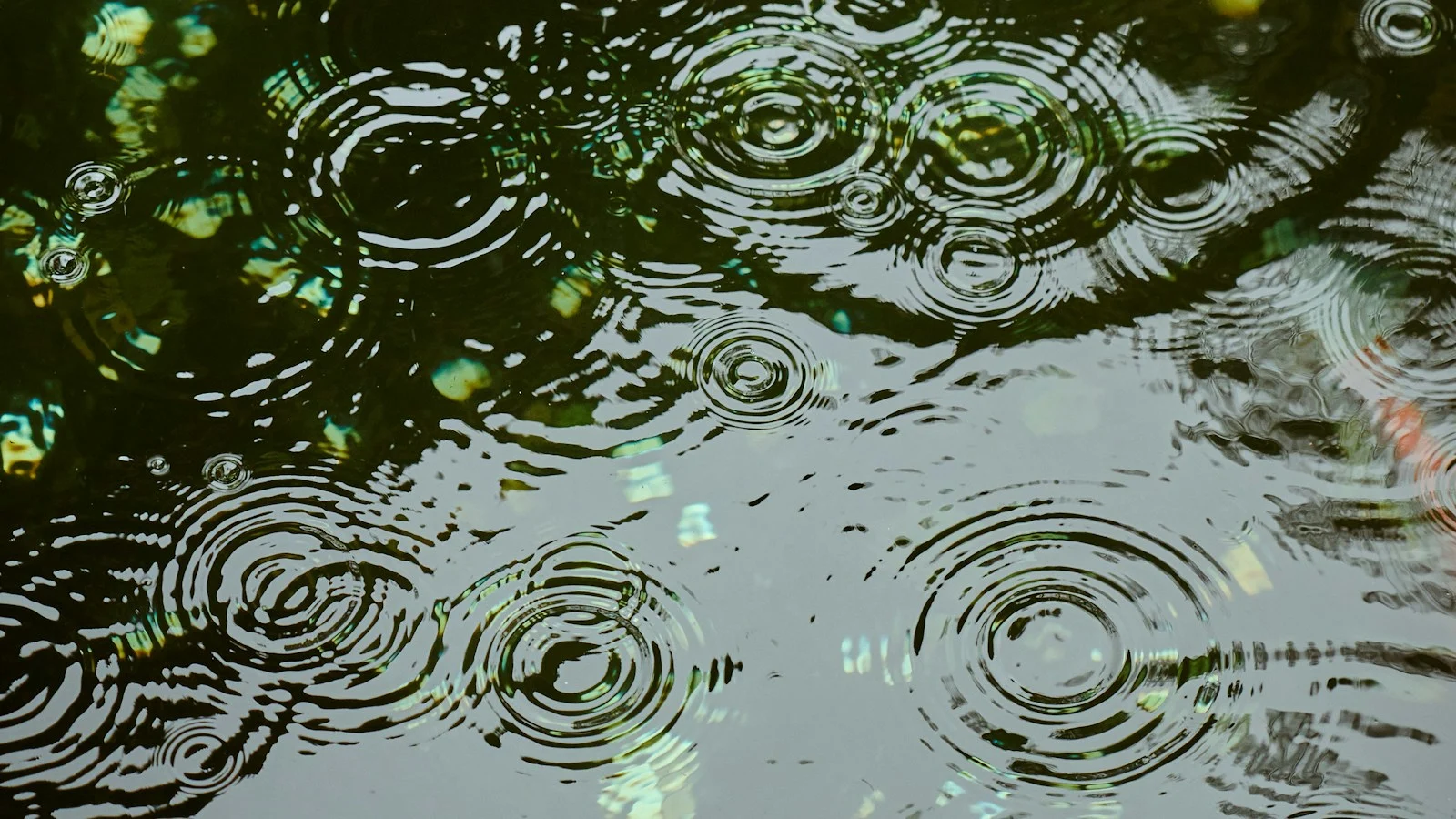
Featured photograph: 一只猫的橘 (@seelean) / Unsplash. Illustrative photograph; it does not show a measured 10 mm rainfall event.