Last updated: August 23, 2026.
Quick Answer
Europe is in the grip of a drought that has pushed the Rhine to its lowest level since records began in 1880, exposed centuries-old “hunger stones” carved to warn of famine, and knocked out more than a fifth of France’s nuclear generating capacity. Around half of EU and UK territory is under drought, wildfires have burned over 505,000 hectares, and the Loire, Po, Rhine and Danube have all fallen to record lows. Counter-intuitively, this drought covers less ground than the notorious 2022 event — but it is landing harder, because it arrived after Western Europe’s warmest June–July on record and on soils already depleted by a dry spring.
A River Running on 14 Centimetres
The clearest measure of this drought is a single gauge in a small German town. Kaub, on the middle Rhine, is the river’s shallowest navigable point and the number the entire European barge industry watches. On 11 August 2026 it read 14 centimetres, with forecasters expecting it to fall to 9 cm within days. Records at Kaub go back to 1880. Nothing lower has ever been measured there.
To put that in perspective: Germany’s Inland Waterway Transport Cooperative reckons barges can still squeeze through with as little as 10 cm of clearance. The Rhine is not quite closed. It is operating with almost no margin at all.
The consequences ripple outward fast, because the Rhine is not a scenic river — it is a logistics artery for the industrial heart of Europe. At Duisburg, the port serving the Ruhr steel region, vessel loading capacity has fallen to roughly one third of normal. Oil barges 110 metres long are being capped at 300–400 tonnes, forcing far more trips for the same cargo. Freight rates for petroleum products between Karlsruhe and the North Sea ports of Amsterdam, Rotterdam and Antwerp have hit €200 per tonne.
The substitution maths is brutal. Covestro, the German polymer maker, says it takes 60 trucks to replace a single barge carrying 1,500 tonnes. Thyssenkrupp, BASF, Lanxess and Evonik have all reported disruption. The utility EnBW expects a low double-digit-million-euro hit to earnings.
Ralph Solveen, senior economist at Commerzbank, put a number on the macro risk: if critically low water persists into mid-September, it could shave 0.35 percentage points off German GDP for the quarter. His view on relief was blunt — a meaningful rise in water levels is unlikely before October.
The Counter-Intuitive Part: This Drought Is Smaller Than 2022
Here is where the story gets more interesting than the headlines suggest. By pure geographic coverage, 2026 is not Europe’s worst recent drought. In late July, about 50% of EU and UK territory sat under drought watch, warning or alert, with 9% at the most severe alert level. In 2022 those figures were 60% and 11%. Even 2018 covered more ground, at 54%.
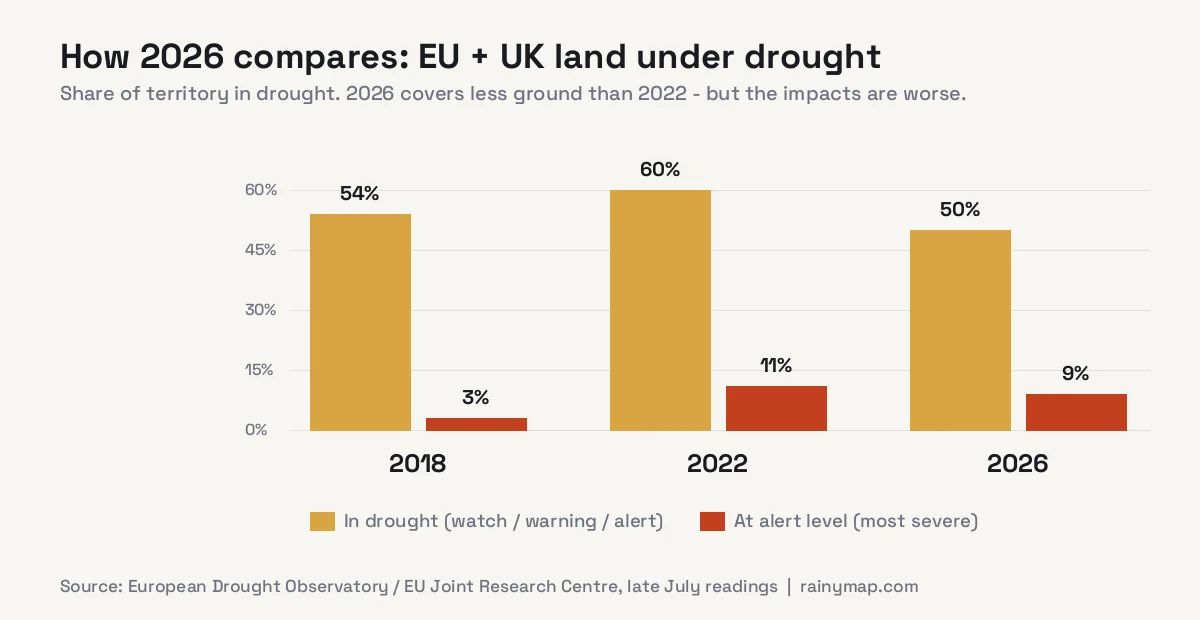
So why is 2026 breaking records that 2022 did not? Three compounding factors:
- It started early. The deficit built from a dry spring, so soils entered summer already depleted rather than being drained by summer alone.
- It stacked on record heat. Western Europe recorded its warmest June–July on record, according to the Copernicus Climate Change Service. Heat does not just fail to add water — it actively removes it through evaporation.
- It kept going. The current heatwave is Europe’s fifth of the summer, affecting roughly 300 million people, more than half the continent’s population.
Drought maps measure how widespread conditions are. They are a poor guide to how deep the damage runs. A slightly smaller drought sitting on hotter ground for longer produced lower rivers than a larger, cooler one.
“If You See Me, Weep”: The Hunger Stones Are Back
For centuries, Europeans carved warnings into boulders that sat on riverbeds, visible only when water fell catastrophically low. These Hungersteine — hunger stones — marked the years when drought meant failed harvests, halted shipping and, in the worst cases, famine. They were messages to the future, written by people who assumed the future would need them.
They are readable again. On the Elbe near Pirna-Oberposta, close to the Czech border, a stone bearing more than 20 inscriptions dating back to 1707 has re-emerged. It is among the largest and best known in Germany. On the Rhine near Leverkusen, north of Cologne, more stones have surfaced, including one carved in 1959.
One clarification worth making, because it is widely muddled in coverage: the most famous inscription of all — “Wenn du mich siehst, dann weine”, “If you see me, weep” — belongs to a stone at Děčín in the Czech Republic, and it has not reappeared in 2026. The stones that have surfaced this summer are real and remarkable, but that particular one is not among them.
What Else the Rivers Gave Up
Falling water has turned European riverbeds into accidental archaeology. On the Danube along the Serbia–Romania border, wrecks from Nazi Germany’s Black Sea fleet have broken the surface again — part of a flotilla of up to 200 vessels scuttled in September 1944 as German forces retreated. Some are reported to still hold munitions.
In Hungary, a Wehrmacht motorcycle was recovered from the Danube near Budapest, alongside anti-tank mines, grenade fragments and artillery shells — most likely war debris from the 1944–45 siege of the city. A separate wreck surfaced near Mohács. And in Bulgaria, near the village of Ryahovo, the retreating Danube exposed something considerably older: the skeleton of a woolly mammoth.
Wildfires: Ahead of a Record Year’s Pace
Drought and fire are the same story told twice. By 5 August 2026, wildfires had burned 505,683 hectares across the EU. At the same point in 2025 the figure was 379,392 hectares — and 2025 went on to become the worst fire year in EU records, with 1,034,552 hectares lost.
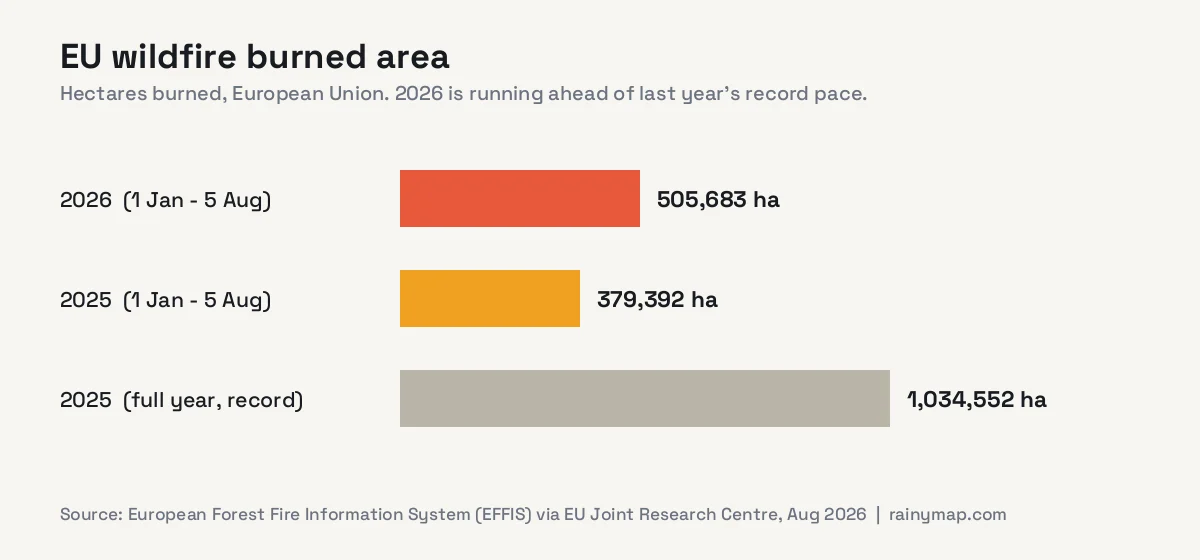
Running a third ahead of a record year, with the traditional peak of the Mediterranean fire season still ahead, is the part that worries fire services. The drought built through spring and early summer in France, Spain and Portugal, curing vegetation into fuel long before the worst heat arrived.
The Energy Squeeze: When Rivers Get Too Warm to Cool Reactors
The least intuitive consequence of a drought is a power problem. On 12 August 2026, more than a fifth of France’s nuclear generating capacity was sitting idle at once. EDF data showed the fleet producing 4.1 gigawatts less than normal — roughly 7% of national demand.
The mechanism is regulatory rather than mechanical. Reactors draw river water for cooling and return it warmer. When a river is already near its legal thermal limit, discharging more heat would push it past the point where aquatic ecosystems can cope, so operators must throttle back or shut down. Low water makes this worse twice over: less volume to absorb heat, and shallower water warms faster. Units at Chooz, Cattenom, Golfech, Bugey, Saint-Alban and Tricastin were all affected.
One additional factor was stranger: jellyfish swarms clogging cooling water intakes, an issue that has hit coastal plants across several countries in recent years.
The same low rivers cut hydropower output. A drought therefore reduces electricity supply at precisely the moment a heatwave drives air-conditioning demand to its annual peak.
The Human and Agricultural Toll
The World Health Organization has reported more than 10,000 excess deaths across five countries during this summer’s heat. Other analyses put the continent-wide figure far higher — Bloomberg has cited around 25,000. Heat mortality estimates vary widely because they are modelled from excess-death statistics rather than counted directly, but every method points the same direction.
Agriculture is absorbing the rest. EU crop forecasts have been cut: winter crops down roughly 1–4% month-on-month, with grain maize and sunflower — both summer crops, both exposed at exactly the wrong moment — revised down 6–7%.
Does This End in October?
Not quickly. Recovering a river like the Rhine takes weeks of sustained, widespread rainfall across the whole catchment — not one thunderstorm, and not one wet week. Commerzbank’s assessment that levels are unlikely to rise meaningfully before October reflects that: catchments this dry absorb the first rains almost entirely, and only start feeding rivers once soils are re-saturated.
There is a longer pattern here too. Europe has now had major drought years in 2018, 2022 and 2026, and the continent is warming faster than any other. Each event arrives on ground that has had less time to recover. The hunger stones were carved as records of rare catastrophe; the interval between readings is getting shorter.
For the wider climate context behind this summer, see our coverage of Europe’s 2026 heatwave and the global pattern behind it and our running tracker on whether 2026 will be the hottest year ever recorded. The same El Niño-influenced pattern drove America’s second heat dome of 2026 weeks earlier.
How to Track It
Drought is the absence of weather, which makes it hard to watch — but the rain that would end it is trackable in real time. Our live rain map shows where precipitation is actually falling across Europe, the live temperature map shows the heat driving evaporation, and the air quality map matters during fire season, when smoke travels far beyond the fire line. For the week ahead, use the 7-day forecast, and for a specific city, browse live radar for 3,300+ locations. Travelling to the region? Our best time to visit guides cover seasonal weather for 19 destinations.
Frequently Asked Questions
How low is the Rhine right now?
The Kaub gauge on the middle Rhine — the river’s shallowest navigable point — read 14 cm on 11 August 2026, with forecasts of 9 cm within days. That is the lowest since records began at Kaub in 1880. Barges can technically still pass with about 10 cm of clearance, but loading capacity at Duisburg has fallen to roughly a third of normal.
What are hunger stones?
Hunger stones (Hungersteine) are boulders in central European riverbeds carved with dates and warnings during historic droughts. They sit below the waterline in normal years and become visible only when levels fall catastrophically low, serving as a warning that drought, failed harvests and disrupted trade have happened before. A stone near Pirna-Oberposta on the Elbe carries more than 20 inscriptions going back to 1707.
Is the 2026 European drought the worst on record?
Not by area. About 50% of EU and UK territory was under drought in late July 2026, compared with 60% in 2022 and 54% in 2018. But it is producing record impacts — the lowest Rhine level ever measured at Kaub, and wildfire area running about a third ahead of 2025, which was itself the EU’s worst fire year on record. A smaller drought on hotter ground for longer has done more damage.
Why did the drought reduce France’s nuclear power output?
Nuclear plants take river water for cooling and discharge it warmer. When rivers are already near their legal temperature limits, operators must reduce output or shut reactors down to avoid harming aquatic life. Low water compounds this: there is less volume to absorb heat, and shallow water warms faster. On 12 August 2026 this left over a fifth of France’s nuclear capacity idle, about 4.1 GW or 7% of national demand.
How many people have died in Europe’s 2026 heat?
The World Health Organization has reported more than 10,000 excess deaths across five countries, while some analyses put the continent-wide total nearer 25,000. Heat deaths are estimated statistically from excess mortality rather than counted directly, which is why published figures differ substantially.
When will the drought end?
Not immediately. Commerzbank expects no meaningful rise in Rhine levels before October. Severely dry catchments absorb early rainfall almost entirely, so rivers only recover once soils are re-saturated — which takes weeks of widespread rain across the whole basin, not isolated storms.
Sources
- EU Joint Research Centre — Worsening drought and record heat grip Europe (12 Aug 2026)
- gCaptain — Rhine River hits record low, deepening shipping crisis
- Euronews — Historic drought: rivers reveal hunger stones, warships and mammoth remains
- The Connexion — How heatwaves and drought are affecting France’s nuclear reactors
- CNN — Western Europe breaks temperature record in a summer plagued by heatwaves and wildfires
- Phys.org / AFP — Low water on Germany’s Rhine threatens new blow to the economy