Last updated: July 16, 2026.
Quick Answer
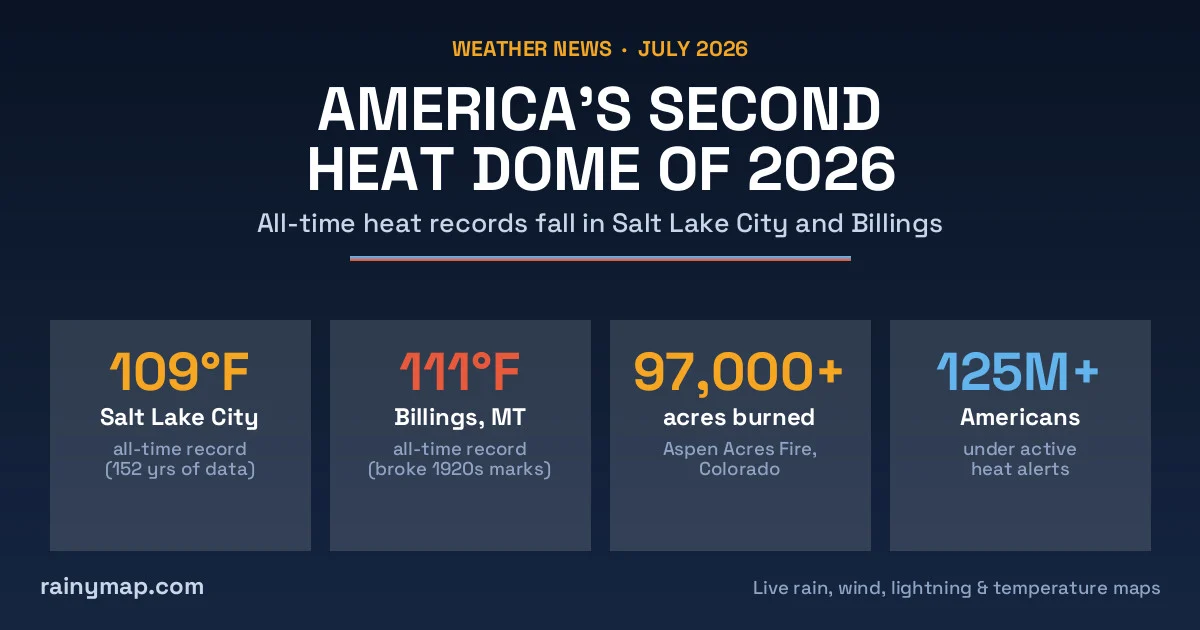
A second heat dome, part of what forecasters are calling a “double heat dome” summer, rebuilt over the Great Basin, Rockies, and Plains on July 12, 2026, and broke records the first one never touched. Salt Lake City hit 109°F that afternoon, its hottest reading in 152 years of record-keeping, while Billings, Montana reached 111°F, an all-time record confirmed by the National Weather Service, alongside 114°F in Miles City and Glendive. The same pattern is feeding the Aspen Acres Fire in Colorado, now well over 97,000 acres, and pushing smoke from more than 800 Canadian wildfires into the upper Midwest and Northeast. Forecasters expect the dome to persist over the Plains through much of the rest of July, with only isolated monsoon relief in the interior West.
Salt Lake City: The Hottest Day in 152 Years of Record-Keeping
Just before 3 p.m. on Sunday, July 12, the National Weather Service’s official station near Salt Lake City International Airport recorded 109°F (43°C), the highest temperature ever measured in the city since record-keeping began in 1874. The previous all-time record of 107°F had been reached four separate times, in 1960, 2002, 2021, and twice in 2022, but never broken outright until this weekend.
The record fell under a strong area of high pressure parked north of the Four Corners, the same broad ridge responsible for record heat across much of the interior West that weekend. An excessive heat warning remained in effect through Monday, July 13, before forecasters flagged rising odds of monsoonal thunderstorms later in the week as the ridge began shifting east.
Montana’s Northern Plains Broke Marks Set in the 1920s
The same ridge pushed temperatures to historic highs across eastern Montana and northern Wyoming on July 12. Miles City and Glendive both hit 114°F, Billings reached 111°F, an all-time record for the city that the National Weather Service and ABC News confirmed had never been recorded before, Jordan hit 109°F, Sheridan, Wyoming reached 108°F, and Bozeman and Livingston both topped out at 105°F. Several of the marks broken that day had stood since the 1920s.
Billings and Salt Lake City recording all-time highs on the same afternoon, roughly 500 miles apart, illustrates just how large this second dome grew: this wasn’t a single city having an unusually hot day, it was an entire swath of the interior West peaking simultaneously.
How This Compares to the East Coast’s July 4th Heat Dome
This is the second major heat dome of the summer, not the first. The first one built over the central US in late June, peaked over the eastern two-thirds of the country on July 2-4, and pushed Central Park to 100°F for the first time since 2012, LaGuardia Airport to 94°F at midnight, the hottest midnight reading on record there, and Atlantic City, New Jersey to 106°F on the Fourth. That heat was blamed for at least 25 deaths as of July 5, and it collapsed into violent storms that knocked out power to hundreds of thousands of customers before easing around July 10-11.
The second dome rebuilt almost immediately, shifting the worst of the heat from the humid East to the drier Great Basin, Rockies, and Plains. By July 14, more than 125 million Americans were under active heat alerts, and together the two domes mean the country has spent nearly three straight weeks with some region locked under dangerous heat.
Wildfire Smoke and Flames Are Compounding the Heat
Heat this extreme doesn’t stay contained to a thermometer reading. In southern Colorado, the Aspen Acres Fire near Beulah, which absorbed the smaller Knowles Fire after it broke out on June 27, has burned more than 97,000 acres. Three firefighters, Emily Barker, Nick Hutcherson, and Sydney Watson, died battling the Knowles Fire before the two merged. The Pueblo County Sheriff’s Office has confirmed at least 254 homes destroyed, with broader estimates of total structures lost, including outbuildings, running as high as 780. Some of the volunteer firefighters who spent days protecting their neighbors’ properties lost their own homes in the process.
Farther north, smoke from more than 800 active wildfires in Canada has been drifting south, degrading air quality across the upper Midwest and Northeast even in areas that haven’t seen the worst of the heat directly.
What Comes Next: Does the Dome Break or Rebuild Again?
AccuWeather’s outlook warns the dome could persist over the Plains through much of the remainder of July before monsoon moisture moving in from the Southwest provides more consistent relief. In the interior West, including Salt Lake City, forecasters say the odds of monsoonal thunderstorms are already rising as the ridge responsible for the record heat shifts east, though any relief there is likely to be brief and localized rather than a clean break in the pattern.
Both of 2026’s heat domes are unfolding against the backdrop of a strengthening El Niño, one of the factors behind 2026 running close to the hottest year ever recorded. A warmer baseline doesn’t cause any single heat dome, but it does raise the floor those domes are building on top of.
How to Track the Heat and What It Triggers
A live temperature map is the fastest way to see exactly how far a heat dome extends at any given moment, rather than relying on a single city’s forecast high. Because heat domes like this one often trigger sudden monsoonal storms or wildfire-driven weather at their edges, pairing it with a live rain map is worth doing too, especially if you’re in Utah, where a Salt Lake City radar page is available, or in Colorado, where the Colorado radar page covers the area around the Aspen Acres Fire.
Frequently Asked Questions
Did Salt Lake City really set an all-time heat record?
Yes. The National Weather Service recorded 109°F in Salt Lake City on July 12, 2026, the hottest temperature in the city’s 152 years of record-keeping, breaking a previous record of 107°F that had last been tied in 2022.
Is this the same heat dome that hit the East Coast on July 4th?
No. It’s a separate, second heat dome. The first one peaked over the eastern US around July 2-4 and eased by roughly July 10-11. This second dome rebuilt over the Great Basin, Rockies, and Plains starting July 12, shifting the worst heat toward the interior West.
What temperature did Billings, Montana reach?
Billings hit 111°F on July 12, 2026, an all-time record confirmed by the National Weather Service and ABC News. Nearby Miles City and Glendive reached an even hotter 114°F the same day.
Is the Aspen Acres Fire connected to the heat dome?
The same high-pressure ridge driving record heat across the interior West has also dried out vegetation and fueled extreme fire behavior in southern Colorado, where the Aspen Acres Fire near Beulah has burned more than 97,000 acres and destroyed at least 254 homes.
When will the heat dome break?
AccuWeather’s outlook suggests the dome could persist over the Plains through much of the rest of July before monsoon moisture provides more sustained relief. Some areas of the interior West may see occasional monsoonal storms sooner, but forecasters don’t expect a clean break in the overall pattern in the near term.
Sources
- KSL.com — Salt Lake City sets new highest temperature ever in 152 years of record keeping
- Montana Right Now — Temperature records broken across Montana as heat wave peaks
- The Colorado Sun — Aspen Acres Fire survivors face an uncertain future after 254 homes destroyed
- The Colorado Sun — Beulah firefighters recount desperate fight to save homes from Aspen Acres Fire
- AccuWeather — Next heat dome to bring 100°F heat to Midwest, perhaps East again
- Mappr — 2026 US Heat Dome: Key Facts and Timeline