Last updated: September 14, 2026. This tracker is refreshed monthly as new data is released by the Copernicus Climate Change Service, NASA GISS, and NOAA.
Quick Answer
Not yet — but it’s on track to get close. Every month of 2026 with published data has ranked among the five warmest on record globally for that month, and a strong-to-very-strong El Niño is still intensifying through the second half of the year. 2024 remains the all-time record holder, at 1.28°C above NASA’s 1951–1980 baseline. Independent scientists, including Columbia University’s James Hansen, argue 2026 is on pace to pass it. NOAA’s official position is more cautious: it’s “virtually certain” 2026 will rank among the ten warmest years ever recorded, and “very likely” it lands in the top five.
2026’s Monthly Temperature Rankings So Far
The table below uses data from the Copernicus Climate Change Service (C3S), the EU’s official climate monitoring body, based on the ERA5 reanalysis dataset.
| Month | Global rank (all-time) | Avg. surface air temp. | Above 1991–2020 average | Above pre-industrial (1850–1900) |
|---|---|---|---|---|
| January 2026 | 5th warmest January | 12.95°C | +0.51°C | +1.47°C |
| February 2026 | 5th warmest February | 13.26°C | +0.53°C | +1.49°C |
| March 2026 | 4th warmest March | 13.94°C | +0.53°C | +1.48°C |
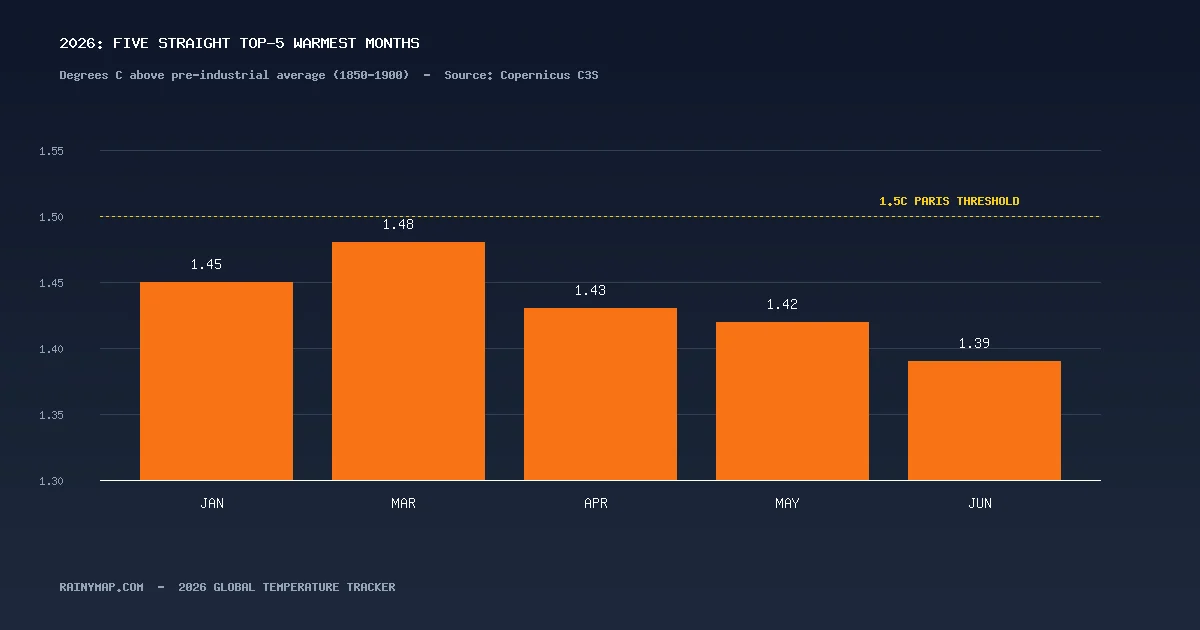
| April 2026 | Joint 3rd warmest April | 14.89°C | +0.52°C | +1.43°C |
| May 2026 | 2nd warmest May | 15.81°C | +0.55°C | +1.42°C |
| June 2026 | 2nd warmest June | 16.54°C | +0.56°C | +1.39°C |
| July 2026 | Joint 2nd warmest July | 16.90°C | +0.67°C | +1.47°C |
| August 2026 | Joint-warmest month ever recorded | 16.96°C | +0.85°C | +1.65°C |
Source: Copernicus Climate Change Service monthly bulletins, January–August 2026.
September update: August 2026 tied July 2023 as the hottest month ever recorded, at 1.65°C above pre-industrial — the first month above 1.5°C since November 2025. Read the full analysis: August 2026 tied the hottest month ever recorded.
The pattern is consistent: no month in 2026 has fallen outside the all-time top five for that calendar month. That’s a notably hotter start than most years, but it is not automatically enough to make 2026 the hottest year overall — that depends on how the second half of the year plays out.
How Does 2026 Compare to 2024, the Current Record Holder?
According to NASA’s GISS analysis, 2024 is the hottest year in the 145-year instrumental record, at 1.28°C above the agency’s 1951–1980 baseline. 2023 and 2025 are effectively tied for second place, with 2025 landing around 1.19°C above that baseline.
- 2024 — hottest year on record (+1.28°C vs. 1951–1980 baseline)
- 2023 / 2025 — statistically tied for second (2025: +1.19°C)
- 2026 — every reported month ranks top-5 for that month; full-year ranking still undecided
Two camps disagree on where this is heading. James Hansen’s team at Columbia University argues 2026 is already on track to exceed 2024, with an even hotter 2027 likely to follow. NOAA’s official stance is more conservative, placing 2026 as “virtually certain” to finish in the top 10 and “very likely” in the top 5 — without committing to a new all-time record until more of the year’s data is in.
Why Is 2026 So Hot? The El Niño Factor
NOAA issued an official El Niño Advisory on June 11, 2026, confirming the pattern had developed in the tropical Pacific. Current forecasts give it roughly 90% odds of reaching at least “strong” intensity, and better than 60% odds of becoming a rare “very strong” event — with peak strength expected in the September–November 2026 window.
El Niño matters because it releases stored heat from the tropical Pacific Ocean into the atmosphere, temporarily pushing global average temperatures higher on top of the underlying warming trend. That’s largely why 2023 and 2024 — both El Niño years — set back-to-back records. It’s also why forecasters increasingly expect the effect to peak not in 2026 itself, but in early-to-mid 2027, roughly six months after the El Niño reaches maximum strength — a lag pattern seen in every major El Niño on record.
Forecasts project a nearly universal dominance of above-normal temperatures across almost all parts of the globe through the June–August 2026 season, with the strongest El Niño signal building into the final quarter of the year.
NOAA Climate Prediction Center, June 2026 outlook
The 1.5°C Threshold — What It Means and Why It Matters
The 1.5°C figure you’ll see constantly in climate coverage refers to warming above the 1850–1900 “pre-industrial” average — the benchmark nations agreed to try to stay under in the 2015 Paris Agreement. A single hot month or year passing 1.5°C doesn’t mean the Paris target has been breached; that’s measured as a multi-decade average. But the recent run of individual months and years above it shows how close the world now sits to that line:
- Global average temperature stayed at or above 1.5°C for 12 consecutive months, from July 2023 through June 2024 — in the ERA5 record, the previous longest streak above that mark was just three months, in 2016.
- The three-year average for 2023–2025 exceeded 1.5°C above pre-industrial levels for the first time ever in a rolling three-year period.
- Multiple individual months in 2026 — including March (+1.48°C), April (+1.43°C), May (+1.42°C) and June (+1.39°C) — have again landed at or just under that threshold.
In short: 2026 isn’t breaking new ground on the 1.5°C question so much as confirming the world is now living inside that margin far more often than it isn’t.
What Do NASA, NOAA, and Independent Scientists Predict for the Rest of 2026?
- NOAA: Virtually certain top-10 finish; very likely top-5. No official record call yet.
- James Hansen / Columbia University: 2026 already on track to top 2024; 2027 likely to be hotter still as El Niño’s lagged warming effect peaks.
- WMO / UN: Warns the intensifying El Niño raises the likelihood of extreme regional weather — heatwaves, drought, and flooding — through late 2026 and into 2027, independent of where the year ranks statistically.
- Copernicus (C3S): Continues to publish month-by-month rankings without projecting a full-year outcome, citing the ENSO transition as the key uncertainty for the second half of the year.
The honest answer, echoed across every one of these sources, is that 2026’s final ranking won’t be settled until agencies finalize the full-year data in January 2027. This article will be updated as each new monthly bulletin lands.
Frequently Asked Questions
Is 2026 currently the hottest year on record?
No. As of the most recent data (June 2026), 2024 still holds the record for hottest year ever measured, at 1.28°C above NASA’s 1951–1980 baseline. 2026’s monthly readings have been very warm — consistently top-5 for each month — but a full year of data is needed before it can be ranked against 2024.
What is currently the hottest year ever recorded?
2024 is the hottest year on record according to NASA, NOAA, and Copernicus, followed by a near-tie between 2023 and 2025.
Why has 2026 been so warm?
A combination of long-term greenhouse gas warming and a newly developed El Niño, officially declared by NOAA on June 11, 2026. El Niño releases heat stored in the tropical Pacific Ocean into the atmosphere, adding a temporary boost on top of the underlying warming trend.
Could 2027 end up hotter than 2026?
Yes — and several scientists think it’s likely. El Niño’s warming effect on global temperatures typically peaks about six months after the event itself peaks. Since this El Niño is forecast to peak in September–November 2026, its strongest influence on global temperatures may not show up until early-to-mid 2027.
When will we know for sure if 2026 sets a new record?
Full-year figures are finalized and published by NASA, NOAA, and Copernicus each January for the preceding year — so a definitive answer for 2026 will arrive in January 2027.
Sources
- Copernicus Climate Change Service — Climate Bulletins
- NASA — 2024 Confirmed as Warmest Year on Record
- NOAA / weather.com — El Niño and the 2026 vs. 2024 Outlook
- James Hansen (Columbia University) — 2026 Global Temperature Update
- Copernicus / Climate Change News — 1.5°C Three-Year Average
- World Meteorological Organization — El Niño Preparedness