Lightning strikes most over Lake Maracaibo in Venezuela, which averages about 233 flashes per square kilometre every year, the highest rate on Earth. Africa is the most lightning-prone continent, with five of the world’s top 10 hotspots in eastern DR Congo. In the United States, Florida gets the most lightning per square kilometre.
Those rankings come from 16 years of NASA satellite data, analysed by a team led by Rachel Albrecht and published in 2016. They counted every flash seen from orbit between 1998 and 2013 and mapped the result at a resolution of about 10 km.
Below you will find the full top 10, why a lake in Venezuela beats everywhere else, where lightning is most common in the US, and why different “lightning capital” claims disagree.
Where Lightning Strikes the Most: Key Facts
- Number 1 in the world: Lake Maracaibo, Venezuela, about 233 flashes per km² per year.
- Top continent: Africa, with 283 of the world’s 500 biggest lightning hotspots.
- Top country for hotspots: DR Congo, with 5 of the top 10.
- Top in Asia: Daggar, Pakistan, in the Hindu Kush foothills (number 6 worldwide).
- Top US state: Florida, 117.6 lightning events per km² in 2025.
- Land vs sea: lightning is about 10 times more common over land than over the ocean.
- Worldwide: about 44 flashes every second, nearly 1.4 billion a year.
Where Does Lightning Strike the Most in the World?
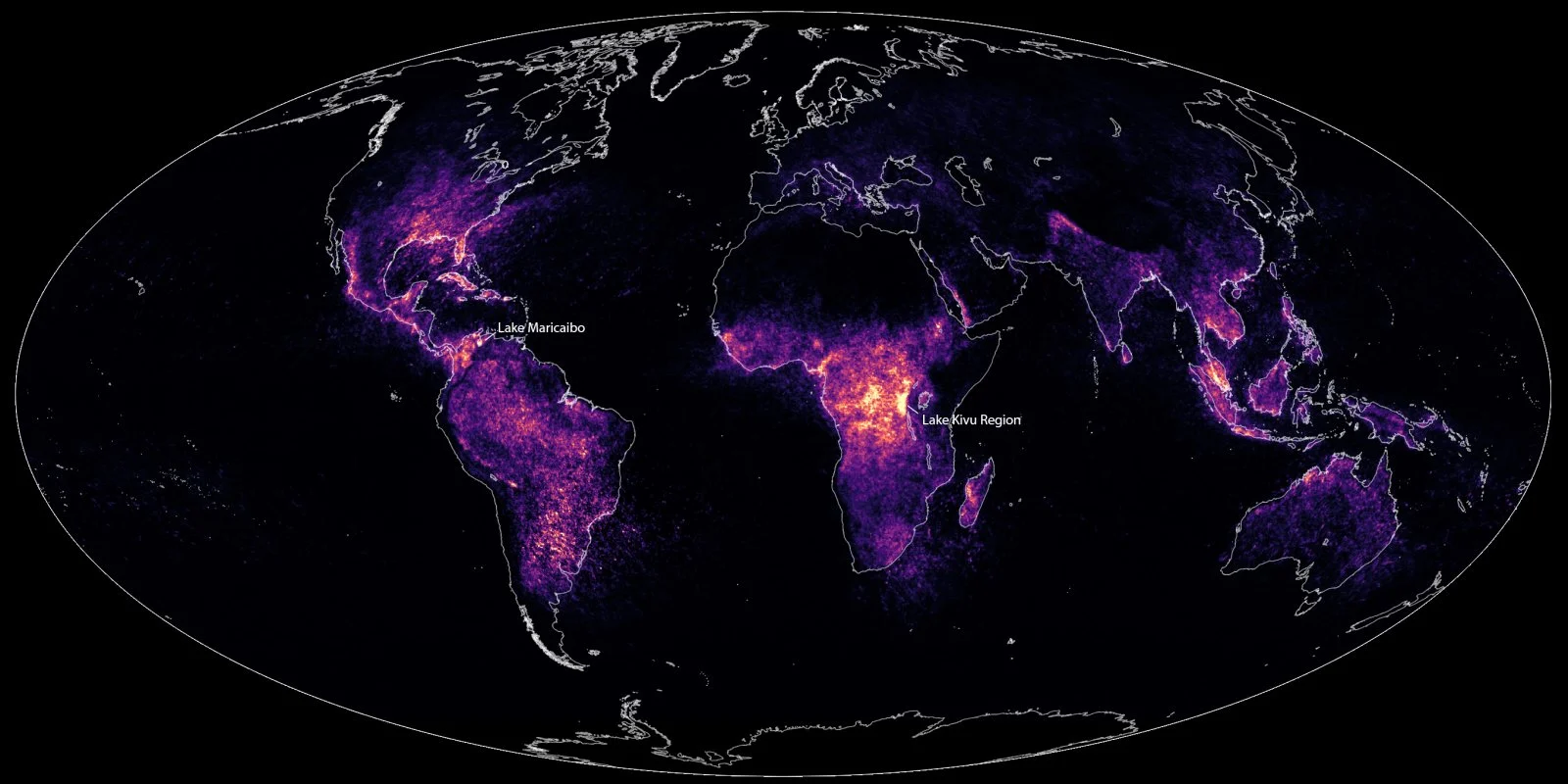
Lightning clusters in the tropics, over land, and especially near mountains and large lakes. That is where hot, humid air is pushed upwards most strongly, building the tall thunderclouds that produce lightning.
The most detailed global count comes from NASA’s Lightning Imaging Sensor (LIS), which flew aboard the Tropical Rainfall Measuring Mission (TRMM) satellite. In a study in the Bulletin of the American Meteorological Society, Albrecht and colleagues used 16 years of its data to rank the 500 most lightning-prone places on Earth. Each hotspot is named after the nearest town with at least 1,000 people.
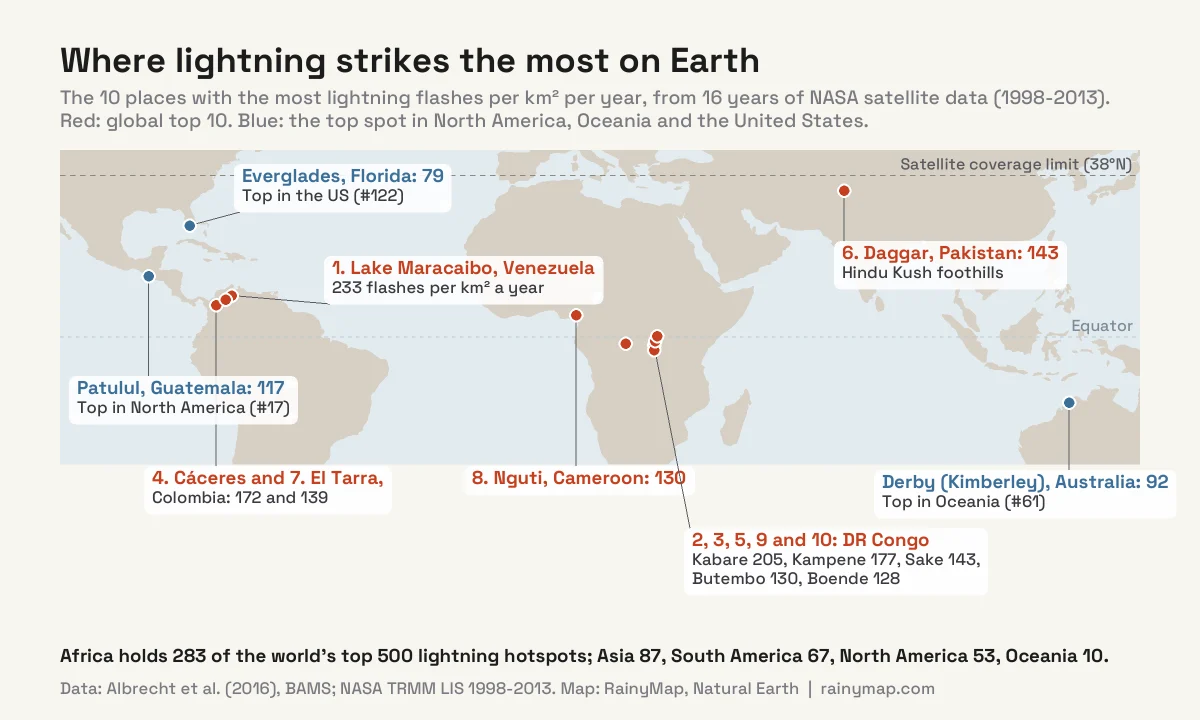
One limitation matters: the satellite orbited between about 38° north and 38° south, so places such as northern Europe, Canada and most of the US interior were outside its view. That does not change the top of the list. Lightning is far more frequent in the tropics than at higher latitudes.
The Top 10 Lightning Hotspots on Earth
Here is the full top 10 from the NASA data. The figure is the average number of lightning flashes per square kilometre per year, counting both cloud-to-ground strikes and flashes inside clouds.
| Rank | Hotspot (nearest town) | Country | Flashes per km² per year | Peak |
|---|---|---|---|---|
| 1 | Lake Maracaibo (Lagunillas) | Venezuela | 232.5 | Night, around 03:00; August to November |
| 2 | Kabare | DR Congo | 205.3 | Afternoon; west of the Mitumba Mountains |
| 3 | Kampene | DR Congo | 176.7 | Afternoon |
| 4 | Cáceres | Colombia | 172.3 | Andes foothills |
| 5 | Sake | DR Congo | 143.2 | Near Lake Kivu |
| 6 | Daggar | Pakistan | 143.1 | Monsoon season; Hindu Kush foothills |
| 7 | El Tarra | Colombia | 138.6 | Catatumbo basin, near Lake Maracaibo |
| 8 | Nguti | Cameroon | 129.6 | Near the Cameroon highlands |
| 9 | Butembo | DR Congo | 129.5 | Afternoon |
| 10 | Boende | DR Congo | 127.5 | Congo Basin |
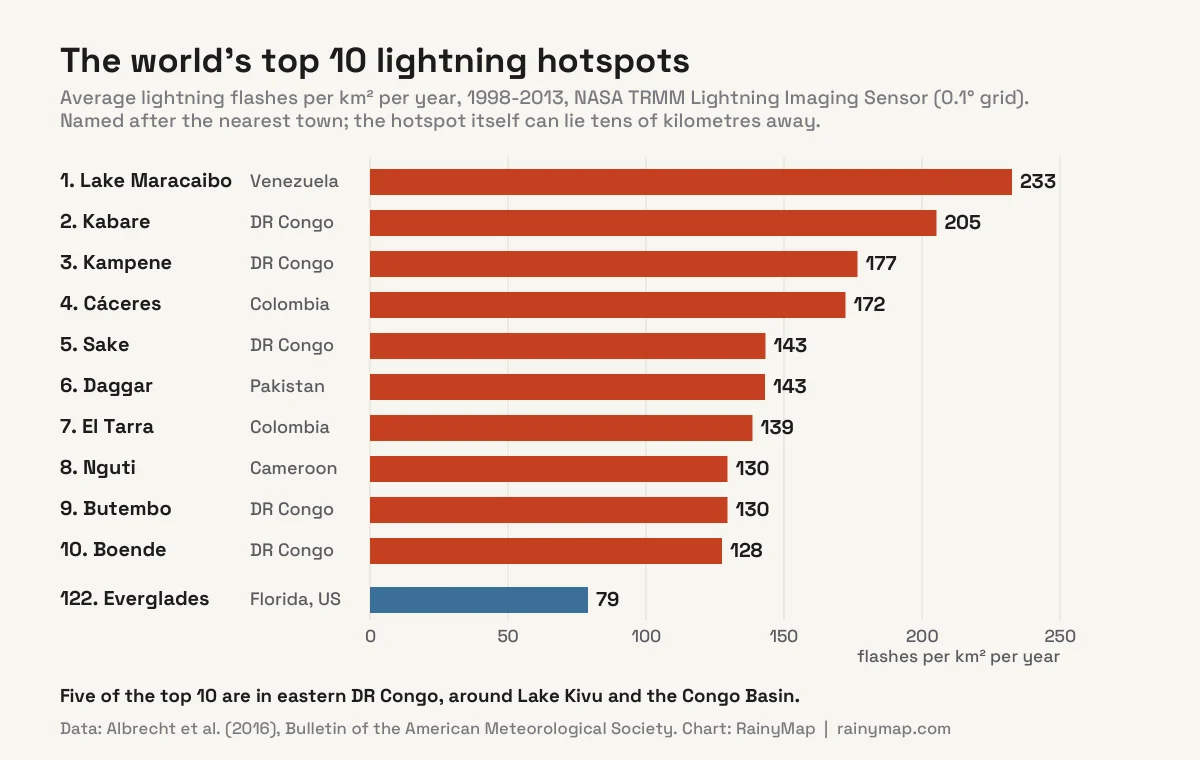
For comparison, the top spot in the United States, over the Everglades about 37 km from Fort Myers, Florida, averages 79 flashes per km² a year. It ranks 122nd in the world. The top spot in North America is Patulul, Guatemala (117, ranked 17th), and the top in Oceania is in Western Australia’s Kimberley region, named after the town of Derby (92, ranked 61st).
Why Is Lake Maracaibo the Lightning Capital of the World?
Lake Maracaibo is a huge, warm body of water almost enclosed by mountains: the Andes to the south-east and the Sierra de Perijá to the west. At night, cooler air drains down the mountain slopes and meets warm, humid air over the lake. The air is forced upwards, and thunderstorms build over the water night after night.
The result is the phenomenon known as the Catatumbo lightning, named after the river that flows into the lake’s south-western corner. According to the NASA study:
- The lake sees lightning on 297 days a year on average.
- Activity peaks at night, between midnight and 05:00, with a maximum around 03:00 local time.
- The busiest season is August to November, with a second, smaller peak in May and June. January and February are almost quiet.
- The area with more than 50 flashes per km² a year covers about 5,500 km².
Guinness World Records lists the Catatumbo lightning for the “highest concentration of lightning”, at almost 250 flashes per km² a year, with storms on up to 300 nights a year and displays lasting up to nine hours. The figures differ a little from NASA’s because they come from different measurements and periods. Both agree that nowhere else comes close. The display is not completely reliable, though: Guinness notes that it stopped from January to April 2010.
Two more of the world’s top 10, Cáceres and El Tarra in Colombia, sit in the same corner of South America, where the Andes meet the warm lowlands.
Why Does Africa Have the Most Lightning?
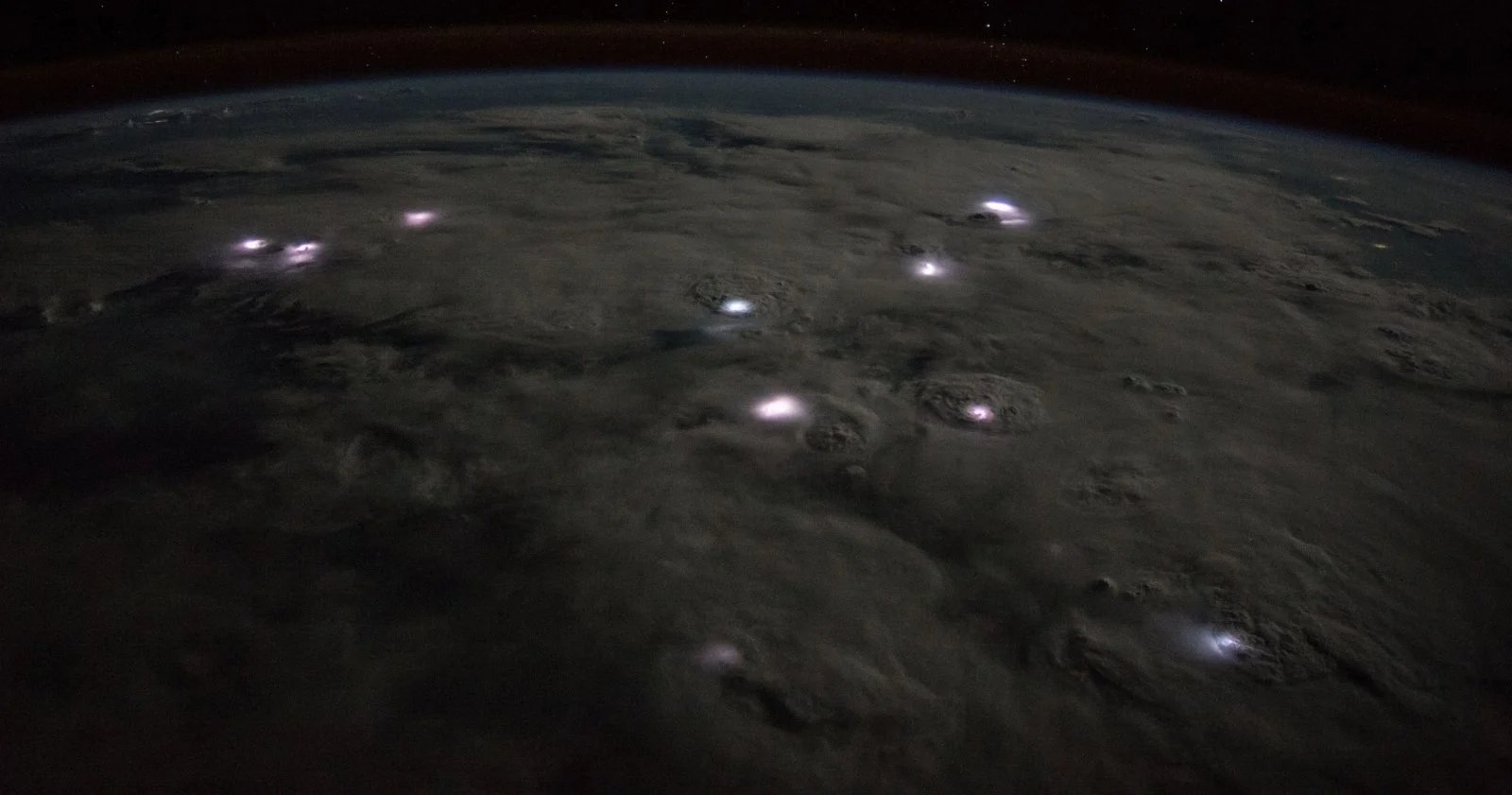
Africa holds 283 of the 500 biggest hotspots, more than every other continent combined. The heart of it lies in eastern DR Congo, on the western side of the Mitumba Mountains near Lake Kivu, near the border with Rwanda. Four of the global top 10 are within a few hundred kilometres of each other there.
The recipe is similar to Maracaibo: warm, moist air from the Congo rainforest pushed up the slopes of high mountains. The timing is different, though. The African hotspots peak in the afternoon, between about 15:00 and 17:00, when the sun has heated the land most, and they are most active from September to May.
Asia’s hotspots behave differently again. The top one, Daggar in Pakistan’s Hindu Kush foothills, is driven by the monsoon: Asian hotspots are busiest from May to October, peaking in September.
Does Lightning Strike More Over Land or Sea?
Over land, by a wide margin. Using NASA’s Optical Transient Detector, Christian and colleagues (2003) found that lightning is on average about 10 times more frequent over land than over the oceans.
The reason is heating. Land warms up quickly in the sun and heats the air above it, which drives strong, fast updrafts. The ocean warms slowly and evenly, so storms over the open sea tend to have weaker updrafts and less of the ice-and-hail mixing that separates electric charge. Our explainer on how lightning forms covers the charging process in more detail.
The same study estimated that lightning flashes about 44 times every second across the planet, nearly 1.4 billion times a year. You will still see “100 times a second” quoted, including on some official pages; that figure dates from a 1925 estimate and is now known to be too high.
Where Does Lightning Strike the Most in the US?
Florida. The National Weather Service office in Melbourne, Florida, calls central Florida the “Lightning Capital” of the United States, and says the corridor from Tampa Bay to Titusville, nicknamed “Lightning Alley”, receives the most lightning in the country. Florida’s sea breezes from both coasts collide over the peninsula on most summer afternoons, setting off daily thunderstorms.
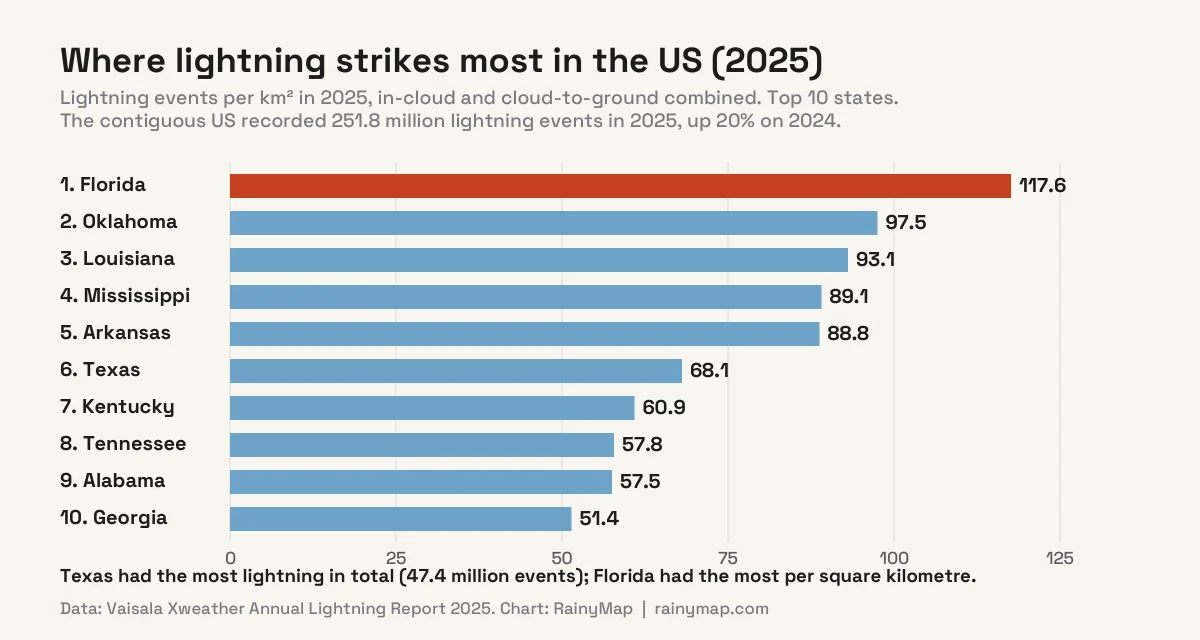
The latest counts agree. In the Vaisala Xweather Annual Lightning Report 2025, Florida had the highest lightning density of any state, at 117.6 events per km², ahead of Oklahoma and Louisiana. Across the contiguous US the network detected 251.8 million lightning events in 2025, up 20% on 2024 and the most in eight years.
| Measure | Leader | Figure (2025) |
|---|---|---|
| Most lightning per km² (state) | Florida | 117.6 events per km² |
| Most lightning in total (state) | Texas | 47.4 million events |
| Most lightning per km² (county) | Seminole County, Florida | 258 events per km² |
| Most lightning in total (county) | Polk County, Florida | 1.06 million events |
| Highest density (town level) | Shady Grove, Oklahoma | 1,160 events per km² |
| Busiest single day | 5 April 2025 | 3.1 million events |
Florida also leads the grim statistics. It has more lightning casualties than any other state, according to the NWS, and in 2026 it accounted for 6 of the 16 US lightning deaths recorded up to late September (NWS preliminary figures). The quietest part of the country is the Pacific West Coast, according to NOAA’s National Severe Storms Laboratory.
Why Do “Lightning Capital” Rankings Disagree?
Search for the lightning capital of the US and you will find Tampa, central Florida, the Everglades and a small town in Oklahoma. They can all be right, because each ranking measures something different:
- What is counted. Some counts include only cloud-to-ground strikes; others count all lightning, including flashes inside clouds, which are far more common.
- How big the area is. A state average, a county, a town and a 10 km satellite grid square give different winners. Shady Grove, Oklahoma, topped Vaisala’s 2025 town-level ranking with 1,160 events per km², while Florida won at state level.
- Which years. One stormy year can reshuffle a single-year ranking. The NASA hotspots are a 16-year average, so they are more stable.
- How it is detected. Satellites see flashes from above; ground networks such as Vaisala’s or the community-run Blitzortung network pick up radio signals. Each misses some lightning the other catches.
Our guide to lightning trackers explains why live maps can disagree about strike counts, too.
Where Does Lightning Strike Within a Storm?
On a local scale, the rule is simple. The National Weather Service says height, pointy shape and isolation are the dominant factors in where lightning strikes. Tall objects send up electrical streamers that meet the descending lightning, so trees, towers, masts, hilltops and a person standing alone in a field are the usual targets.
- Lightning does strike the same place twice. The Empire State Building is hit an average of 23 times a year, according to the NWS.
- Metal does not attract lightning. Wearing jewellery or carrying a phone makes no difference to whether you are struck.
- Lightning can strike well away from the rain. Bolts can land 10 to 15 miles (16 to 24 km) from a storm. Our guide on how far away lightning is shows how to judge the distance.
We bust more of these in lightning myths debunked.
How to See Where Lightning Is Striking Right Now
Hotspot maps show where lightning is most common over many years. To see where it is striking today, use a live map.
- Open RainyMap’s real-time lightning map. It shows strikes around the world, usually within seconds.
- Zoom out over Venezuela at night or central Africa in the afternoon, and you will often see the hotspots in action.
- Read the colours: new strikes are white, then turn yellow, orange and red as they age. Our guide on how to read a lightning map explains every symbol.
- Tap Use My Location to check for storms near you. If strikes are within about 10 km, go indoors.
For the weather behind the flashes, see what causes thunderstorms.
Frequently Asked Questions
Where does lightning strike the most in the world?
Over Lake Maracaibo in north-west Venezuela. NASA satellite data from 1998 to 2013 show an average of about 233 lightning flashes per square kilometre per year there, the highest rate on Earth. Most of it happens at night, in thunderstorms that build over the lake almost every evening from August to November.
Which continent has the most lightning?
Africa. Of the world’s 500 most lightning-prone spots identified by Albrecht and colleagues in 2016, 283 are in Africa, against 87 in Asia, 67 in South America, 53 in North America and 10 in Oceania. The Congo Basin and the mountains around Lake Kivu are the main centre.
Where does lightning strike the most in the US?
Florida. It had the most lightning per square kilometre of any state in 2025 (117.6 events per km², Vaisala Xweather), and the National Weather Service says the corridor from Tampa Bay to Titusville, known as “Lightning Alley”, receives the most lightning in the country. Texas has the most lightning in total because it is so large.
What is the lightning capital of the world?
Lake Maracaibo in Venezuela. Guinness World Records lists its “Catatumbo lightning” for the highest concentration of lightning, at almost 250 flashes per square kilometre a year. NASA’s satellite study puts the figure at about 233. Either way, no other place on Earth comes close.
What is the lightning capital of the United States?
Central Florida. The National Weather Service calls it the lightning capital of the US, and the stretch between Tampa and Orlando has the highest frequency of cloud-to-ground lightning in the country, according to NOAA’s National Severe Storms Laboratory.
Does lightning strike more over land or sea?
Over land, by far. NASA’s Optical Transient Detector found that lightning is about 10 times more frequent over land than over the oceans on average, because land heats up faster in the sun and drives stronger updrafts.
How many times does lightning strike the Earth each second?
About 44 times per second on average, or nearly 1.4 billion flashes a year, according to NASA satellite measurements published by Christian and colleagues in 2003. The often-quoted figure of 100 strikes per second is an older, higher estimate.
Where does lightning usually strike during a storm?
The tallest, most pointed and most isolated objects nearby: trees, towers, hilltops, and people standing in open fields. The National Weather Service says height, pointy shape and isolation are the dominant factors, and that metal makes no difference to where lightning strikes.
Can lightning strike the same place twice?
Yes, often. The National Weather Service notes that the Empire State Building is hit an average of 23 times a year. Tall, exposed objects are struck again and again, which is exactly why lightning rods work.
When does lightning strike the most?
It depends on the place. Over land, most thunderstorms peak in the afternoon and early evening, after the sun has heated the ground. Lake Maracaibo is the famous exception: its lightning peaks around 03:00 local time. Globally, lightning follows the warm season, so the Northern Hemisphere is busiest in June to August.
Sources
Facts checked on 14 November 2026. Hotspot figures are 1998-2013 averages from NASA’s TRMM Lightning Imaging Sensor (Albrecht et al., 2016); US figures are for 2025 (Vaisala Xweather). Maps and charts: RainyMap.
- Albrecht, R. I. et al. (2016), Where Are the Lightning Hotspots on Earth? Bulletin of the American Meteorological Society 97(11)
- Full text of Albrecht et al. (2016) in the NOAA Institutional Repository
- Christian, H. J. et al. (2003), Global frequency and distribution of lightning as observed from space by the Optical Transient Detector (NASA)
- Guinness World Records: Highest concentration of lightning
- Vaisala Xweather: Annual Lightning Report 2025
- US National Weather Service, Melbourne: Florida lightning facts
- NOAA National Severe Storms Laboratory: Lightning FAQ
- US National Weather Service: Lightning myths
- US National Weather Service: Lightning fatalities 2026
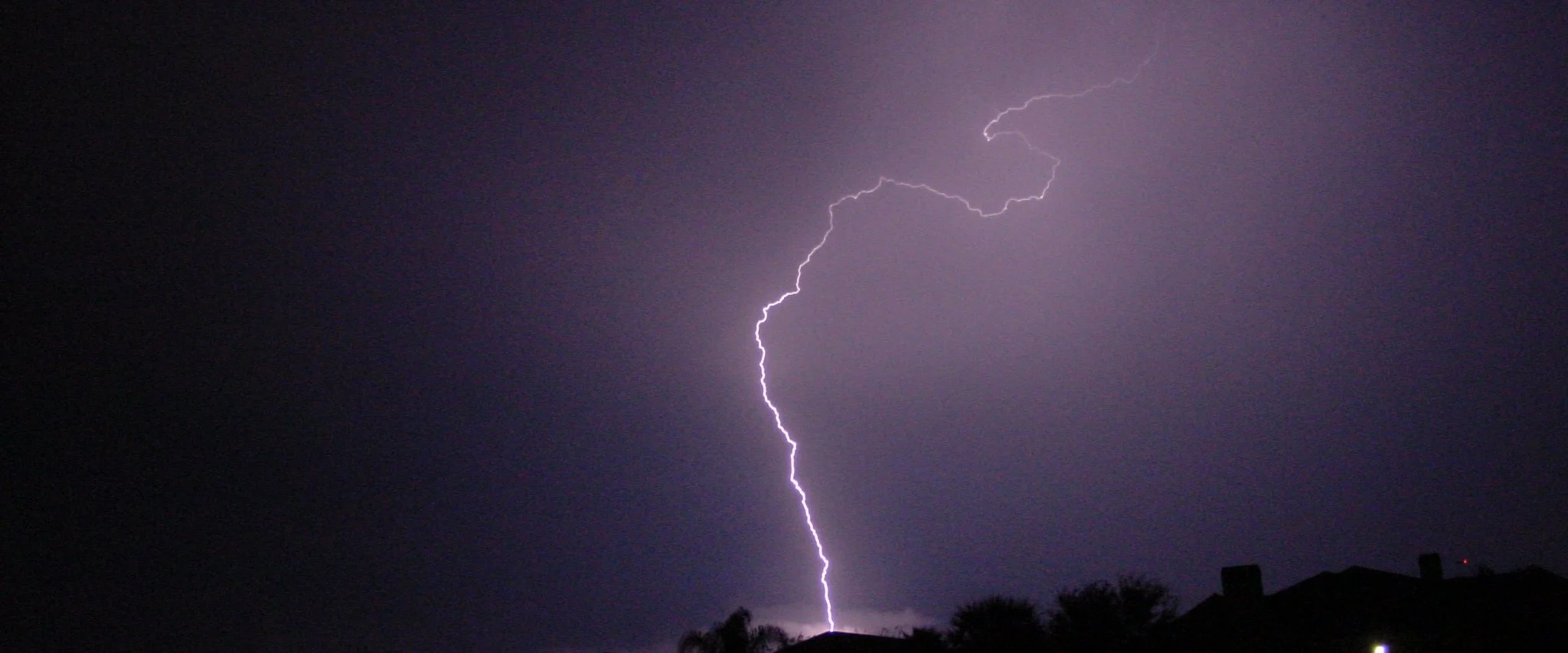
Featured image: lightning over Tampa, Florida. Photo: Christopher Hollis / Wikimedia Commons (public domain).