
A 30% chance of rain means there is a 3 in 10 chance that rain falls at your location during the forecast period. It does not mean it will rain for 30% of the day, or that 30% of the area will get wet. In US forecasts, “rain” here means at least 0.01 inch (0.25 mm), so even a few drops count.
The percentage answers one narrow question: will any rain reach this spot in this time window? It says nothing about how long it rains or how hard. That is why a 90% chance can turn out to be drizzle and a 30% chance can end in a soaking.
Below we explain the official definition, what each percentage means in plain words, and what we found when we pulled real forecasts for 10 cities and checked how hourly and daily chances fit together.
Chance of Rain at a Glance
- The number is a probability for your location, not a share of the day or of the map.
- It counts any measurable rain: 0.01 inch (0.25 mm) in US forecasts, 0.1 mm per hour at the UK Met Office.
- It always belongs to a time window. A 40% chance “this afternoon” is not the same as 40% “today”.
- It says nothing about amount. Read the millimetres or inches separately.
- Longer windows mean higher chances, but you cannot add hourly percentages together.
- Near the time, the radar wins. A live rain map shows what is actually coming.
What Does Chance of Rain Mean?
The official name is probability of precipitation, or PoP. The US National Weather Service (NWS) defines it as the likelihood, expressed as a percentage, of a measurable precipitation event (0.01 inch) at a particular point during a specified time period. The NWS office in Peachtree City, Georgia gives the classic example: a forecast of “40 percent chance of rain” means a 40% chance that the point you care about gets at least 0.01 inch.
The easiest way to picture it is to imagine many days with exactly the same forecast. On a 30% day, it would rain at your house on about 3 days in 10 and stay dry on the other 7. Each single day, of course, either rains or it does not. The percentage describes the forecaster’s uncertainty, not the weather itself.
Snow, sleet and hail count too. For frozen precipitation, the NWS uses its melted water equivalent, so the threshold is the same 0.01 inch of liquid.
How Forecasters Calculate the Chance of Rain: Confidence × Area
To turn a weather situation into one number, many NWS forecasters use a simple method described by the NWS office in Paducah, Kentucky: multiply how confident they are that rain will develop by how much of the forecast area it would cover.
- 80% sure × 50% of the area = 40%. Showers will very probably form, and they will hit about half the county.
- 40% sure × 100% of the area = 40%. A rain band might arrive, and if it does, everyone gets wet.
Both forecasts say 40%, but the weather would feel completely different. The first is a day of hit-and-miss showers; the second is a gamble on a single system. This is why the words around the number matter.
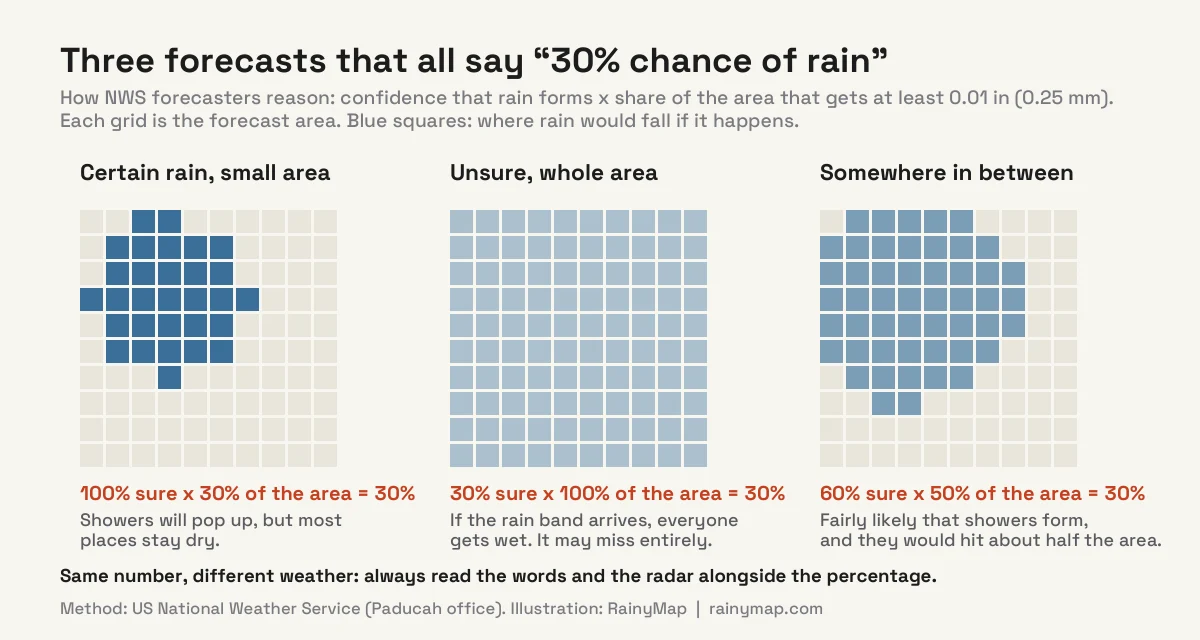
Officially, the result is still a point probability: the chance at any given spot in the area. The confidence × area method is how forecasters reason their way to it, not a separate definition.
What Do 20%, 30%, 50% and 70% Chance of Rain Mean?
US forecasts pair each percentage with standard wording, defined in the NWS Zone Forecast Product specification. Once you know the code, the words tell you as much as the number. “Scattered showers” signals hit-and-miss rain over part of the area; “rain likely” signals that rain is expected but its timing or reach is uncertain.
| Chance of rain | NWS wording | Shower coverage word | What it means for your plans |
|---|---|---|---|
| 10% | Often not mentioned | “Isolated” (or nothing) | Rain is unlikely where you are. Go ahead. |
| 20% | “Slight chance” | “Isolated” | About 1 day in 5 like this brings rain to your spot. Fine for most plans; keep a jacket in the car. |
| 30% | “Chance” | “Scattered” | Probably dry, but 3 in 10 days like it are not. Have a plan B for anything that rain would ruin. |
| 40-50% | “Chance” | “Scattered” | A coin toss. Take an umbrella and check the radar before you leave. |
| 60-70% | “Likely” | “Numerous” | Expect rain at some point. Move outdoor plans indoors or to a dry window in the hourly view. |
| 80-100% | No qualifier: just “rain” or “showers” | None | Rain is all but certain. Now the question is how much and when. |
“Isolated”, “scattered” and “numerous” are coverage words. The NWS uses them for showers and thunderstorms, which pop up in some places and miss others. A day of steady rain from a large weather front gets no coverage word, because it will rain almost everywhere if it rains at all.
Is a 30% Chance of Rain a Lot? Will It Rain?
Probably not where you are, but do not bet the barbecue on it. A 30% chance means that about 7 out of 10 days with this forecast stay dry at your spot. It is the lowest value the NWS labels plain “chance”, one step up from “slight chance” at 20%.
Three things decide whether 30% should change your plans:
- The time window. 30% for a 6-hour afternoon is more meaningful than 30% across a whole day.
- The type of rain. “Scattered showers” can mean short, heavy bursts that miss most people but drench a few. Check our guide to planning outdoor events with rain radar.
- The cost of being wrong. For a dog walk, 30% means nothing. For an outdoor wedding, it means booking the tent.
At 50%, rain and no rain are equally likely. At 70%, the NWS says rain is “likely”, and you should plan as if it will rain at some point, then use the hourly forecast to find the dry gaps.
Chance of Rain vs Amount of Rain: A Real Forecast
We pulled MET Norway’s forecast for Bergen, Norway, on the evening of 14 November 2026. MET Norway publishes both an hourly chance of rain and an expected amount with a low-to-high range, which makes it a good place to see how the two numbers differ.
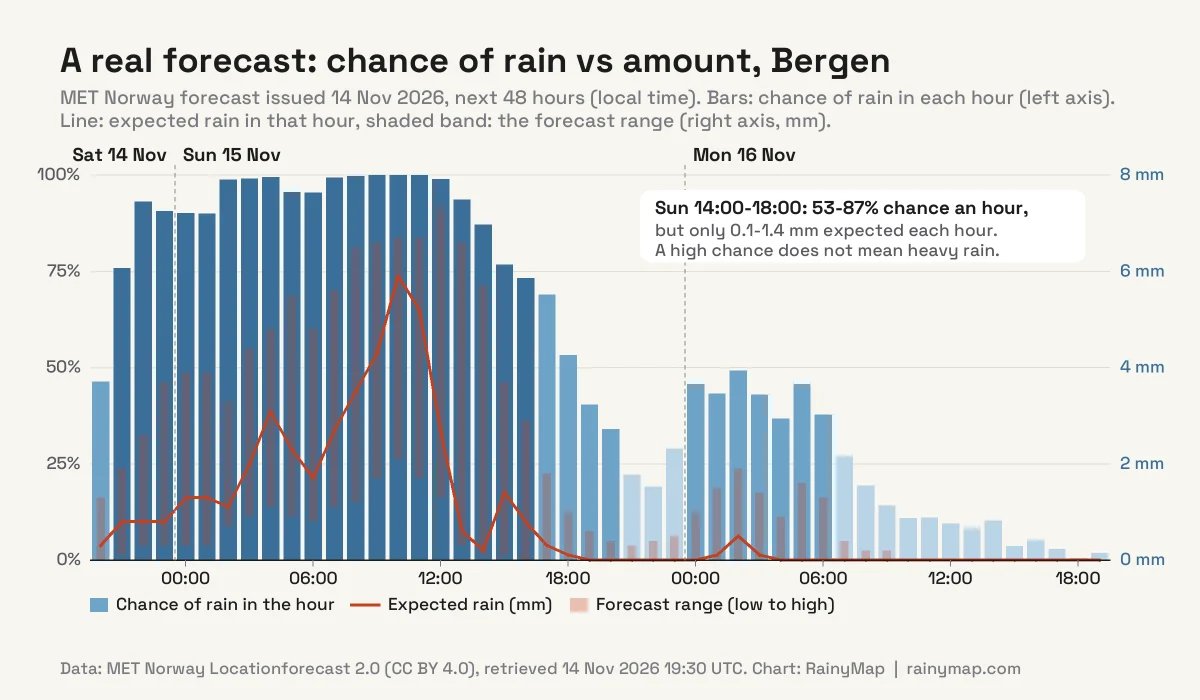
- Sunday morning: a 99 to 100% chance in every hour, with up to 5.9 mm expected in a single hour. That is a genuinely wet morning.
- Sunday afternoon (14:00 to 18:00): still a 53 to 87% chance each hour, but only 0.1 to 1.4 mm expected per hour. High chance, little rain: showers and drizzle.
- Monday night: about 40 to 50% each hour, with almost nothing expected. A coin toss for a few drops.
Over the whole 48 hours, the forecast added up to about 44 mm, nearly all of it between Saturday evening and Sunday midday. If you only looked at the percentages, Sunday afternoon would look nearly as bad as Sunday morning. It is not. Yr, MET Norway’s public weather service, shows this as a minimum-to-maximum rain interval: a narrow range such as 1-2 mm is more certain than a wide one such as 5-15 mm.
To judge what an amount will feel like, see is 10 mm of rain a lot?, which compares 1, 5, 10, 20 and 50 mm.
Why the Daily Chance of Rain Is Higher Than the Hourly Chance
A common puzzle: your app says 60% for the day, yet no single hour shows more than 30%. That is not an error. A longer window gives rain more chances to reach you, so the chance for a whole day is usually higher than the chance for any one hour inside it.
It is tempting to do the maths yourself, but neither obvious approach works. Adding six hourly 30% chances gives 180%, which is impossible. Treating each hour as an independent coin flip gives 88%, which is far too high. We tested this on real forecasts.
Our test: on 14 November 2026 we downloaded MET Norway forecasts for 10 cities: Bergen, Oslo, Trondheim, Tromsø, Stockholm, Gothenburg, Copenhagen, Helsinki, Tallinn and Riga. For every six-hour period where the hourly chances ranged between 10% and 90% (302 periods in all), we compared MET Norway’s own six-hour chance with the six hourly chances inside it.
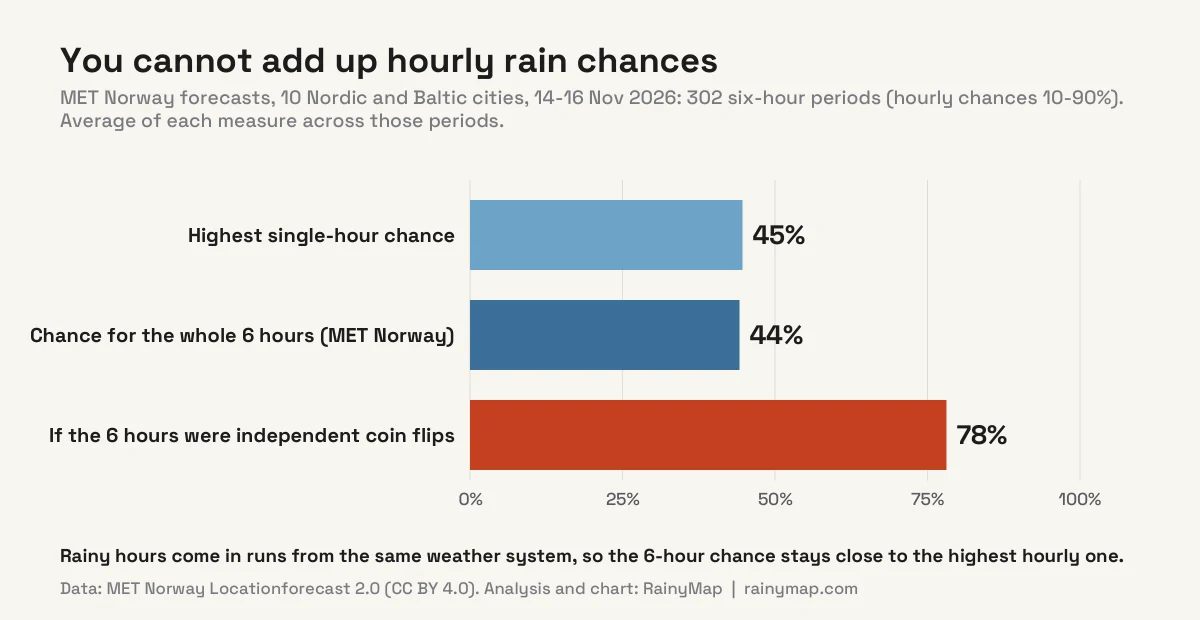
- The six-hour chance averaged 44%, while the highest hourly chance in the same period averaged 45%.
- Treating the hours as independent would have given 78% on average.
- In 64% of the periods, the six-hour chance was within 10 percentage points of the highest hourly chance.
The reason is that rain comes in runs. If a band of rain arrives at 14:00, it is probably still around at 15:00, so the hours are strongly linked. A practical rule: the chance for a longer period is roughly the highest hourly chance in it, plus a little if several hours are high.
One caveat from our data: the hourly and six-hourly figures are calculated separately, so they do not always fit together neatly. In some periods the six-hour chance was even a little lower than the highest single hour. Read the numbers as rough guidance, not as values to add and multiply. Weather apps rarely explain how they build their daily figure, so when the timing matters, look at the hourly view.
Do People Understand the Chance of Rain?
Not very well, and it is not their fault. In 2002, researchers led by Gerd Gigerenzer asked 750 pedestrians in New York, Amsterdam, Berlin, Milan and Athens what “a 30% chance of rain tomorrow” meant. They could choose between rain in 30% of the region, rain for 30% of the time, or rain on 30% of days with this forecast.
In New York, about two-thirds picked the correct answer: days. In all four European cities, the most popular answer was “30% of the time”, and the correct answer was rated the least appropriate. The study, published in Risk Analysis in 2005, argued that the problem is the missing reference: forecasts rarely say “30% of what”. The authors also found that on average people said they would take an umbrella once the chance reached about 50 to 55%, whichever meaning they had in mind.

How Accurate Is the Chance of Rain?
A good probability forecast is “calibrated”: on all the days a forecaster says 30%, it should rain about 30% of the time. Two studies in the journal Monthly Weather Review checked exactly that.
- The Weather Channel (2004-2006): a study of 42 US locations found its near-term forecasts of 40% to 90% were well calibrated. Low values were not. When it forecast a 20% chance for the same day, it rained only 5.5% of the time, a “wet bias” that errs towards predicting rain (Bickel and Kim, 2008).
- NWS (2008-2010): a follow-up study of about 13 million forecasts from 734 US stations found the NWS slightly under-forecast in the middle of the scale: a 40% forecast behaved more like 45% (Bickel, Floehr and Kim, 2011). The same study found the commercial forecasts it tested mostly added no skill to the NWS forecasts.
The lesson: the numbers are close to honest, but not exact. Treat 10% and 20% as “unlikely”, 30% to 60% as “genuinely uncertain”, and 70% or more as “plan for rain”. Forecasts also get better the closer you are to the time, which is why we recommend checking the radar shortly before you head out.
Why Weather Apps Show Different Chances of Rain
Different forecasters define the percentage in slightly different ways. The biggest differences are the rain threshold and the length of the time window.
| Forecaster | What the % measures | Rain threshold | Time window |
|---|---|---|---|
| US National Weather Service | Chance that any given point in the forecast area gets measurable rain | 0.01 in (0.25 mm) | The forecast period, e.g. “this afternoon” |
| UK Met Office | Chance that precipitation falls at some point in the period | 0.1 mm (hourly) or 0.3 mm (3-hourly) | 1 or 3 hours |
| MET Norway / Yr | Chance of precipitation in the period, shown next to a minimum-to-maximum amount | Not stated | 1, 6 or 12 hours |
| Phone weather apps | Usually one of the above, re-processed. Few apps publish their method | Varies | Hour or whole day |
The Met Office counts at least 0.1 mm in an hour, or 0.3 mm in three hours, and includes drizzle, sleet, snow and hail. MET Norway shows its chance next to a minimum and maximum amount, as in the Bergen chart above. So the same afternoon can honestly be “40%” in one app and “60%” in another: one may be talking about a single hour, the other about the whole afternoon.
If an app shows one number for the whole day, open the hourly view. It tells you when the rain is most likely, which matters more than the daily figure. Our 7-day weather forecast shows the expected rain in millimetres hour by hour, so you can see when the wet spells fall.
How to Check If Rain Is Coming Right Now
A percentage is the best a forecaster can say hours or days ahead. In the last hour or two, you can do better by looking at the rain itself.
- Open RainyMap’s real-time rain map and tap Use My Location.
- Play the last hour of radar to see which way the rain is moving and how fast.
- Read the colours: our guide to rain radar colours explains which shades mean drizzle and which mean a downpour.
- If the radar is empty but it is raining, the rain may be too light or too low for the radar beam. Here is why rain radar sometimes shows nothing.
Curious where rain is falling worldwide? Our map of where it is raining right now shows every active rain area on one screen.
Frequently Asked Questions
What does a 30% chance of rain mean?
It means there is a 3 in 10 chance that your location gets at least a small amount of rain (0.01 inch, about 0.25 mm, in US forecasts) during the forecast period. Put another way: on 10 days with this forecast, it would rain where you are on about 3 of them. It does not mean rain for 30% of the time or over 30% of the area.
What does a 40% chance of rain mean?
A 4 in 10 chance of measurable rain at your location during the forecast period. The National Weather Service’s own example: a 40% forecast for this afternoon means a 40% chance of rain at any point in the county between noon and 6 p.m. It is close to a coin toss, so take an umbrella.
Is a 30% chance of rain high?
No. It means rain is more likely not to happen than to happen: about 7 days in 10 with this forecast stay dry at your spot. In US forecasts it is the lowest value labelled plain “chance” rather than “slight chance”. It is worth a backup plan for a wedding or a match, not for a walk.
What does a 70% chance of rain mean?
A 7 in 10 chance that rain falls at your location at some point during the period. The National Weather Service calls this “likely”, and the Met Office describes 70% as “a 7 in 10 chance that precipitation will fall at some point during that period”. It says nothing about how long it rains or how heavily.
Does a 100% chance of rain mean it will rain all day?
No. It means the forecaster is sure that at least some rain falls at your location during the period. That could be one 10-minute shower or a downpour that lasts all day. Check the hourly view and the expected amount in millimetres or inches to find out which.
Does chance of rain mean the percentage of the area that will get rain?
Not directly. The official US definition is the chance of rain at any given point in the area. Forecasters often get there by multiplying how sure they are that rain will form by how much of the area it would cover, so 100% confidence × 30% coverage and 30% confidence × 100% coverage both come out as 30%.
What is the difference between chance of rain and amount of rain?
The chance tells you how likely it is to rain at all. The amount tells you how much falls if it does. A 90% chance of 0.3 mm is a near-certain drizzle; a 30% chance of 20 mm is an unlikely but serious downpour. Our guide to whether 10 mm of rain is a lot shows what the amounts feel like.
Why is the daily chance of rain higher than the hourly chances?
Because a longer window gives the rain more opportunities to reach you. But you cannot add up the hourly numbers: rainy hours tend to come in runs from the same weather system. In our sample of 302 six-hour periods from MET Norway forecasts, the six-hour chance averaged 44%, almost the same as the highest single hour (45%), not the 78% you would get by treating each hour as a separate coin flip.
What does PoP mean in a weather forecast?
PoP stands for probability of precipitation, the official name for the chance of rain (or snow). The US National Weather Service defines it as the likelihood, as a percentage, of a measurable precipitation event of 0.01 inch or more at a particular point during a specified time period.
At what chance of rain should you take an umbrella?
There is no official cut-off. In a study of 750 people in five cities, people said on average they would take an umbrella once the chance reached about 50 to 55%. A sensible rule: at 40% or more, take one; below that, check the radar before you leave and decide from what is actually on its way.
Why does the chance of rain keep changing?
Forecasts are updated as new observations and computer model runs arrive, often every hour or so for the next day. A chance that drops from 60% to 20% usually means the rain is now expected to pass to one side or arrive later. Closer to the time, a live rain map beats any percentage.
Sources
Facts checked on 14 November 2026. The Bergen example and the 302-period comparison are RainyMap’s own analysis of MET Norway forecasts downloaded on 14 November 2026 (data: MET Norway, CC BY 4.0).
- US National Weather Service, Paducah: Probability of Precipitation (PoP), including the confidence × area method
- US National Weather Service, Peachtree City: What does “40 percent chance of rain” mean?
- US National Weather Service: Zone Forecast Product specification (PoP wording, Table 1)
- Met Office: What does this forecast mean? (probability of precipitation)
- Yr (MET Norway and NRK): Weather forecasts and uncertainty
- MET Norway: Locationforecast 2.0 data model
- Gigerenzer et al. (2005), “A 30% chance of rain tomorrow”: how does the public understand probabilistic weather forecasts? Risk Analysis 25(3)
- Bickel and Kim (2008), Verification of The Weather Channel probability of precipitation forecasts. Monthly Weather Review 136
- Bickel, Floehr and Kim (2011), Comparing NWS PoP forecasts to third-party providers. Monthly Weather Review 139
Featured image: a rain shaft from a single shower over the sea at sunset, seen from Man-of-War Bay, Tobago. Photo: NOAA (public domain).