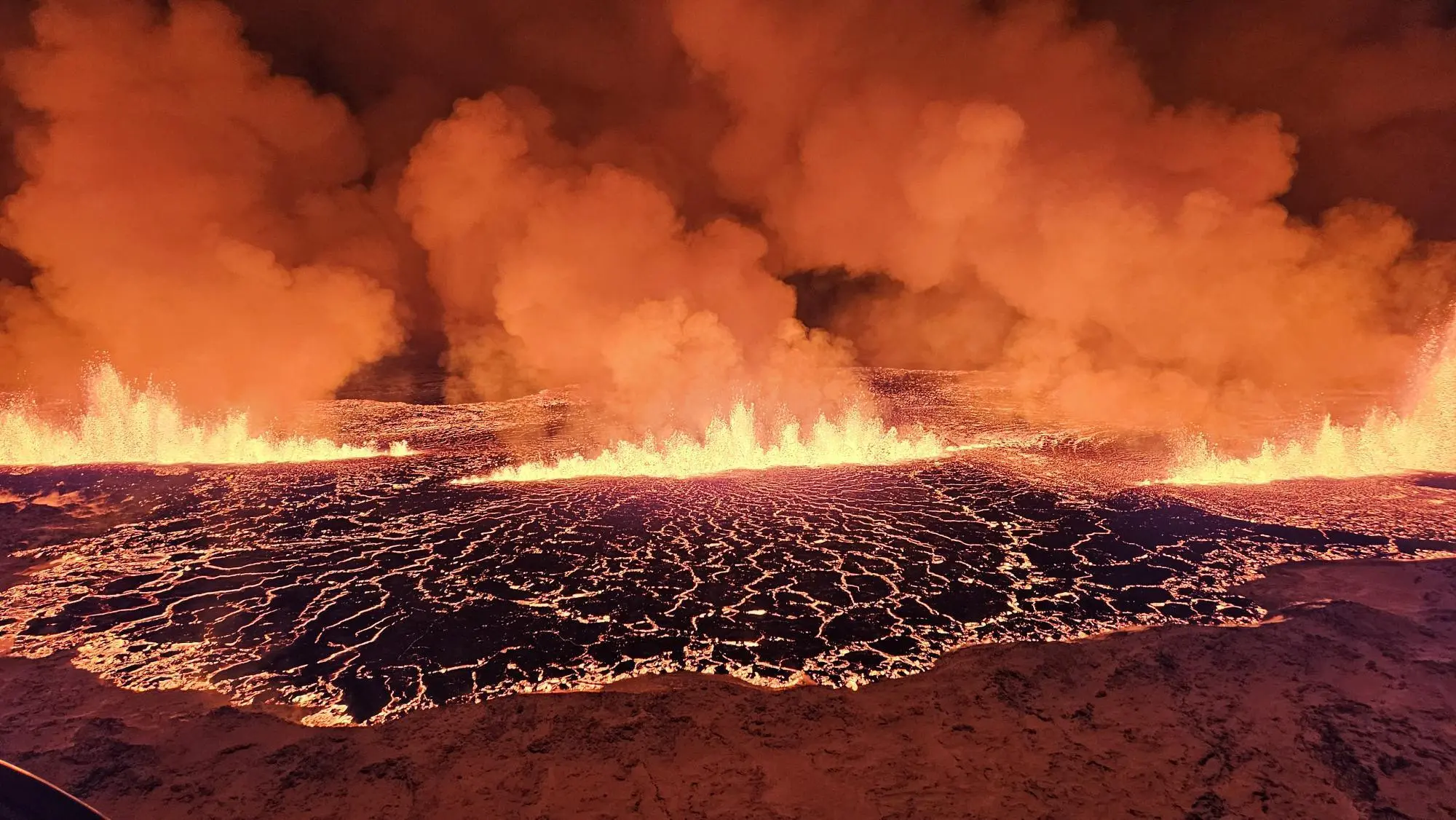
A volcano has erupted on the Reykjanes peninsula of south-west Iceland after weeks of intense earthquake activity.
About 4,000 people were earlier evacuated from the fishing town of Grindavik and the nearby Blue Lagoon geothermal spa was closed.
The eruption started north of the town at 22:17 local time (22:17 GMT), the Icelandic Met Office said.
It will not bring the same level of disruption as one in 2010, which halted European air travel, an expert said.
The region around the capital Reykjavik has been experiencing an increase in earthquake activity since late October.
The Met Office said that the eruption was located about 4km (2.5 miles) north-east of Grindavik and the seismic activity was moving towards the town.
Images and videos posted on social media showed lava bursting from the volcano just an hour after an earthquake swarm, or seismic events, were detected.
The eruption can be seen from Reykjavik, which is about 42km (26 miles) north-east of Grindavik.
One eyewitness there told the BBC that half of the sky in the direction of the town was “lit up in red” from the eruption, and smoke could be seen billowing into the air.
Police have warned people to stay away from the area.
The length of the crack in the volcano is about 3.5km, with the lava flowing at a rate of around 100 to 200 cubic metres per second, the Met Office said.
It added that this was many times more than in previous eruptions on the Reykjanes peninsula in recent years.
A senior police officer at the Civil Defence told national broadcaster RUV that the eruption had happened quickly and appeared to be “quite a large event”.
Vidir Reynisson said the lava appeared to be flowing in all directions from a large crack in the volcano.
Iceland’s foreign minister, Bjarni Benediktsson said on X, formerly Twitter, that “there are no disruptions to flights to and from Iceland, and international flight corridors remain open”.
“The jets [of lava] are quite high, so it appears to be a powerful eruption at the beginning,” he said.
Update: What Happened After December 2023
Updated 3 September 2026. The original report above describes the eruption as it began on 18 December 2023. It turned out to be the first of many.
That opening eruption lasted just three days. But it marked the start of a sustained volcanic episode along the Sundhnúkur crater row that has continued for well over a year, with nine eruptions in that system between December 2023 and August 2025 — the twelfth on the Reykjanes peninsula since activity resumed there in March 2021, after roughly 800 dormant years.
The eruptions that followed
- 14–16 January 2024 — the closest call. Lava emerged less than 100 metres from the outermost houses in Grindavík, and several homes were destroyed.
- 8–10 February 2024 — lava severed a hot-water pipeline, cutting heating to more than 26,000 people in the middle of an Icelandic winter.
- 16 March – 8 May 2024 — the longest of the series at 54 days.
- 29 May – 22 June 2024 — the largest lava field, with peak flow reaching 1,500–2,000 cubic metres per second.
- 20 November – 8 December 2024 — second-largest by volume, but by then defensive barriers meant little disruption.
- 16 July – 5 August 2025 — the most recent, lasting 21 days, and the first at which formal public access to the site was permitted.
What became of Grindavík
The prediction in the original report — that this would not repeat the 2010 air-travel chaos — held. International flights were never meaningfully disrupted, and Keflavík airport stayed open throughout.
The cost fell almost entirely on one town. Grindavík’s roughly 3,000 residents faced repeated evacuations across 2024, and the town remains largely uninhabited today, though it is technically open and guided tours of the town and its lava defences have run since November 2024. Many residents have moved away permanently. The Blue Lagoon reopened and now operates normally, closing briefly as a precaution when activity resumes.
Where things stand in 2026
As of late August 2026 no eruption is under way, and seismic activity is low. But roughly 29.1 million cubic metres of magma have accumulated beneath Svartsengi since the last eruption ended, and the Icelandic Meteorological Office considers a further dike intrusion the most likely outcome. Iceland and Keflavík airport are unaffected.
The pattern of the past three years suggests this is a pause rather than an ending. For the authoritative picture, follow the Icelandic Meteorological Office.