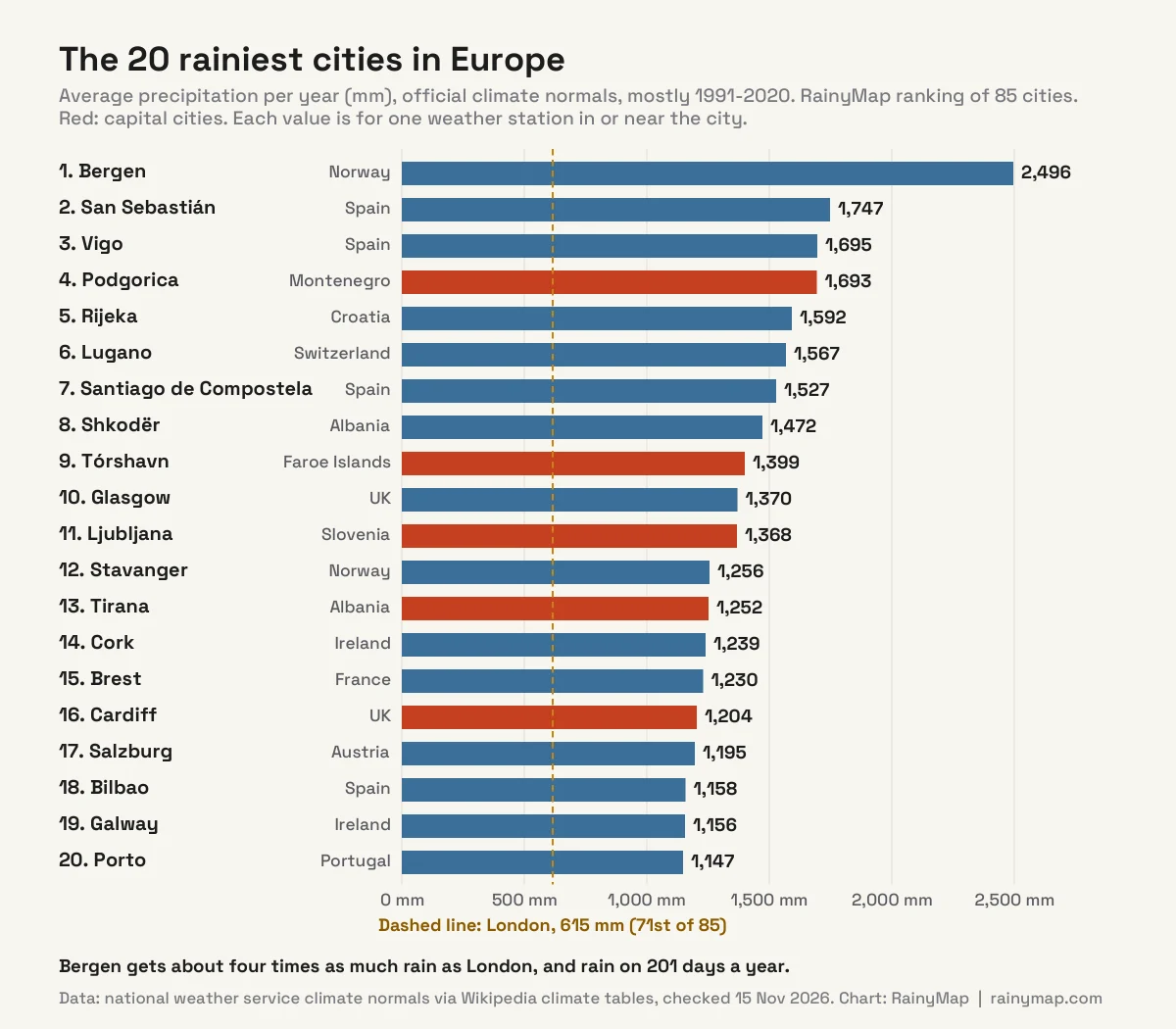
The rainiest city in Europe is Bergen, Norway, with about 2,496 mm of precipitation a year and rain on about 201 days, according to its official 1991-2020 climate normals. The rainiest capital is Podgorica, Montenegro, at about 1,693 mm. London, despite its reputation, gets only 615 mm a year, less than Rome.
We compared the official climate averages for 85 European cities, from Reykjavík to Istanbul, and ranked them two ways: by how much rain falls in a year and by how many days it rains. The two lists look very different, which explains a lot of the arguments about which city is “the rainiest”.
Below you will find the top 20, the rainiest capitals, the cities with the most rainy days, and why the wettest corners of Europe are where they are.
Rainiest Cities in Europe: Key Facts
- Rainiest city: Bergen, Norway, 2,496 mm a year and 201 rainy days.
- Rainiest capital: Podgorica, Montenegro, 1,693 mm a year.
- Most rainy days after Bergen: Tórshavn (192), Hamburg (188), Munich (182).
- Rainiest UK city: Glasgow, 1,370 mm and 181 rainy days.
- London: 615 mm, 71st of 85, and drier than Rome, Milan and Nice.
- Driest: Madrid, 416 mm, and Seville, with rain on only 50 days a year.
- Rainiest month: November in most of Europe.
The 20 Rainiest Cities in Europe
This ranking uses each city’s official climate normals: 30-year averages published by national weather services, mostly for 1991-2020. Where a city has several weather stations, we used the main station listed for the city. A “rainy day” is a day with at least 1 mm of precipitation, the standard threshold most European weather services use.
| # | City | Country | Rain per year | Rainy days* | Wettest month | Station, period |
|---|---|---|---|---|---|---|
| 1 | Bergen | Norway | 2,496 mm | 201 | December (290 mm) | Bergen-Florida, 1991–2020 |
| 2 | San Sebastián | Spain | 1,747 mm | 143 | November (227 mm) | Hondarribia airport, 15 km east, 1991–2020 |
| 3 | Vigo | Spain | 1,695 mm | 126 | November (236 mm) | Vigo Airport, 1991–2020 |
| 4 | Podgorica (capital) | Montenegro | 1,693 mm | – | November (261 mm) | Podgorica, 1991–2020 |
| 5 | Rijeka | Croatia | 1,592 mm | 99 | November (211 mm) | Rijeka, 1991–2020 |
| 6 | Lugano | Switzerland | 1,567 mm | 100 | May (178 mm) | Lugano, 1991–2020 |
| 7 | Santiago de Compostela | Spain | 1,527 mm | – | October (214 mm) | Santiago de Compostela, 1991–2020 |
| 8 | Shkodër | Albania | 1,472 mm | 99 | November (213 mm) | Shkodër, 1991–2020 |
| 9 | Tórshavn (capital) | Faroe Islands | 1,399 mm | 192 | January (167 mm) | Tórshavn, 1991–2020 |
| 10 | Glasgow | UK | 1,370 mm | 181 | December (161 mm) | Glasgow (Bishopton), 1991–2020 |
| 11 | Ljubljana (capital) | Slovenia | 1,368 mm | – | September (160 mm) | Ljubljana-Bežigrad, 1991–2020 |
| 12 | Stavanger | Norway | 1,256 mm | 165 | October (148 mm) | Stavanger Airport Sola, 1991–2020 |
| 13 | Tirana (capital) | Albania | 1,252 mm | 115 | November (151 mm) | Tirana Airport, 1991–2020 |
| 14 | Cork | Ireland | 1,239 mm | 162 | December (137 mm) | Cork Airport, 1991–2020 |
| 15 | Brest | France | 1,230 mm | 160 | December (155 mm) | Brest-Guipavas, 1991–2020 |
| 16 | Cardiff (capital) | UK | 1,204 mm | 153 | December (140 mm) | Cardiff Bute Park, 1991–2020 |
| 17 | Salzburg | Austria | 1,195 mm | – | August (164 mm) | Salzburg Airport, 1991–2020 |
| 18 | Bilbao | Spain | 1,158 mm | – | November (171 mm) | Bilbao Airport, 1991–2020 |
| 19 | Galway | Ireland | 1,156 mm | 170 | October (130 mm) | Galway, 1981–2010 |
| 20 | Porto | Portugal | 1,147 mm | 105 | November (166 mm) | Porto Airport, 1991–2020 |
Three regions dominate the list. Western Norway and the Atlantic fringe of Britain, Ireland and France catch rain from almost every Atlantic storm. Galicia and the Basque Country in northern Spain are far wetter than most people expect from Spain. And the mountains around the Adriatic Sea, from Rijeka to Podgorica and Shkodër, get some of the heaviest downpours in Europe, mostly in autumn.
Why Is Bergen the Rainiest City in Europe?
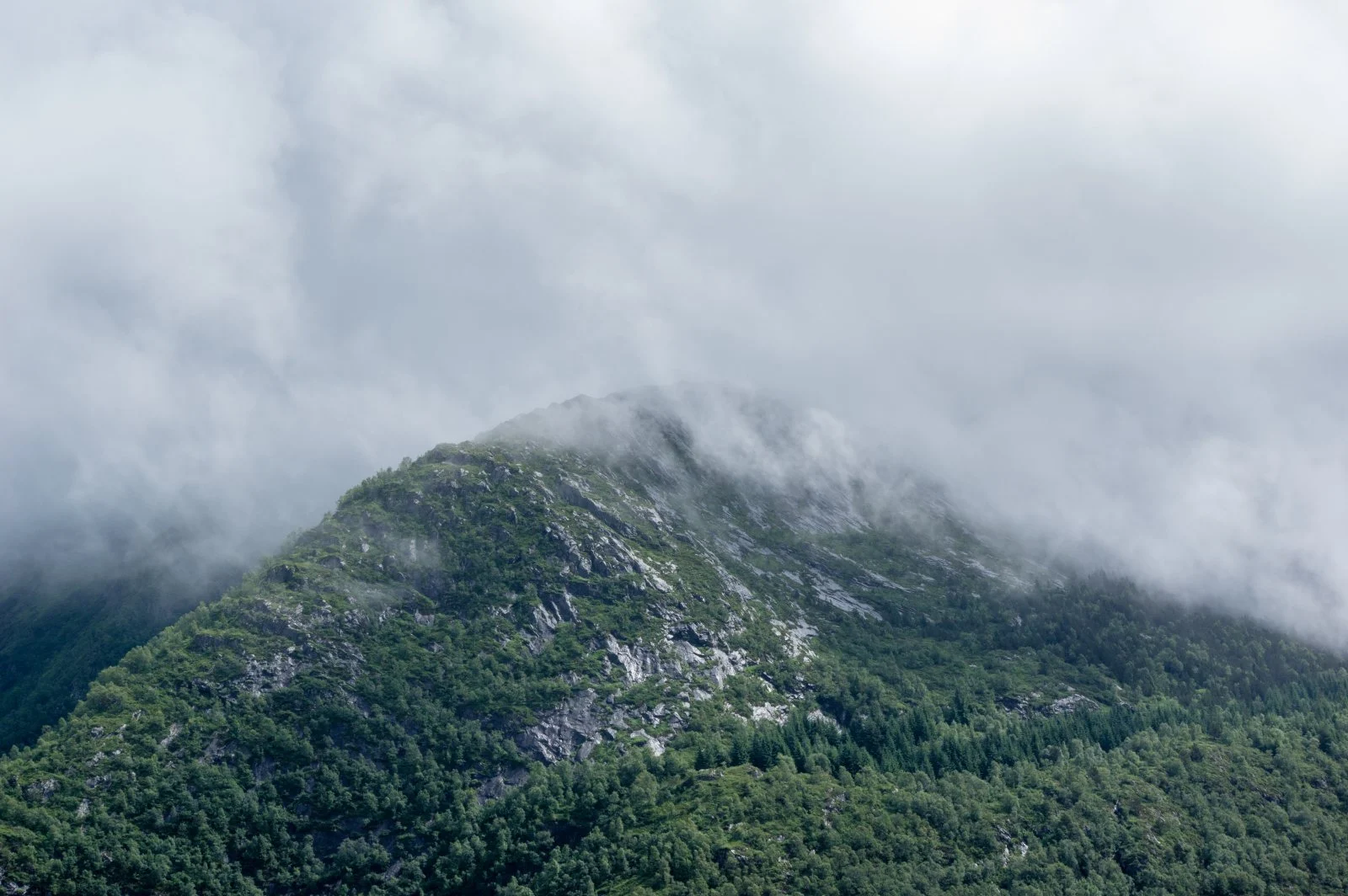
Bergen sits on Norway’s west coast, facing the Atlantic and surrounded by seven mountains. Moist air arrives on the prevailing westerly winds, hits the steep slopes behind the city and is forced upwards. As it rises it cools, and the water vapour condenses into cloud and rain. Meteorologists call this relief, or orographic, rainfall.
The result is about 2,496 mm a year at the city’s main weather station, Bergen-Florida, and rain on 201 days of the year. The wettest month is December, with about 290 mm on average. Wet years go far beyond that. MET Norway measured 3,027 mm at Florida in 2007, and the City of Bergen’s climate figures list 2,806 mm for 2024. “Europe’s rainiest city” is not an official title, but it is how a 2007 study in the International Journal of Biometeorology described Bergen, and our comparison supports it: no other city in our list comes within 700 mm.
What Is the Rainiest Capital City in Europe?
Podgorica, the capital of Montenegro, with about 1,693 mm a year. It is not rainy in the way Bergen is: Podgorica has hot, dry summers and plenty of sunshine. But between October and March, storms from the Mediterranean run into the Dinaric Alps around the city and drop huge amounts of rain in a short time. November alone averages about 261 mm, more than London gets in four months.
| # | Capital | Country | Rain per year | Rainy days* |
|---|---|---|---|---|
| 1 | Podgorica | Montenegro | 1,693 mm | – |
| 2 | Tórshavn | Faroe Islands (Denmark) | 1,399 mm | 192 |
| 3 | Ljubljana | Slovenia | 1,368 mm | – |
| 4 | Tirana | Albania | 1,252 mm | 115 |
| 5 | Cardiff | Wales (UK) | 1,204 mm | 153 |
| 6 | Bern | Switzerland | 1,022 mm | 122 |
| 7 | Sarajevo | Bosnia and Herzegovina | 950 mm | – |
| 8 | Reykjavík | Iceland | 876 mm | 155 |
| 9 | Zagreb | Croatia | 874 mm | – |
| 10 | Amsterdam | Netherlands | 850 mm | 133 |
At the other end, Madrid (416 mm), Athens (433 mm) and Prague (454 mm) are the driest capitals we checked. Berlin, Stockholm and Warsaw, often thought of as grey and damp, all get less than 560 mm a year.
Which European Cities Have the Most Rainy Days?
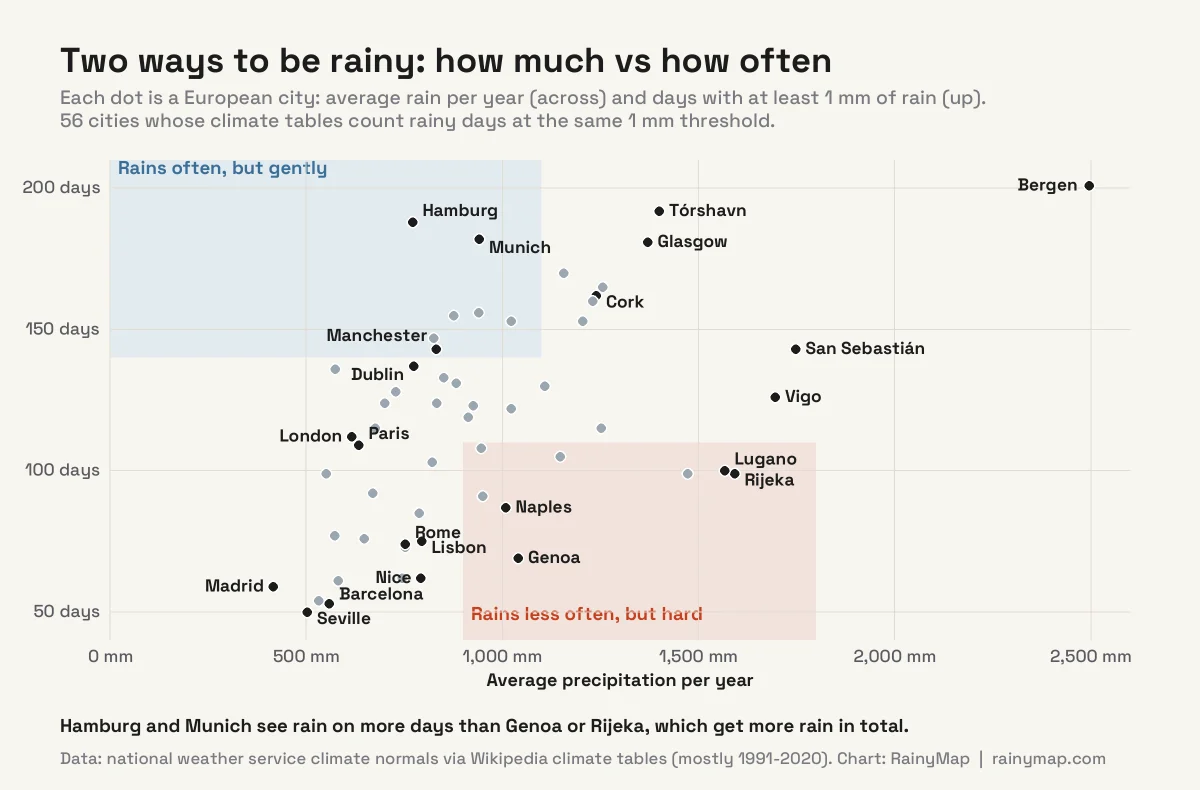
Ranking by days tells a different story. Hamburg and Munich are nowhere near the top 20 for total rainfall, but they see rain more often than almost anywhere else in Europe. Genoa, Rijeka and Nice are the opposite: plenty of rain in total, delivered in fewer, heavier bursts.
| # | City | Rainy days a year | Rain per year |
|---|---|---|---|
| 1 | Bergen, Norway | 201 | 2,496 mm |
| 2 | Tórshavn, Faroe Islands | 192 | 1,399 mm |
| 3 | Hamburg, Germany | 188 | 771 mm |
| 4 | Munich, Germany | 182 | 940 mm |
| 5 | Glasgow, UK | 181 | 1,370 mm |
| 6 | Galway, Ireland | 170 (1981–2010) | 1,156 mm |
| 7 | Stavanger, Norway | 165 | 1,256 mm |
| 8 | Cork, Ireland | 162 | 1,239 mm |
| 9 | Brest, France | 160 | 1,230 mm |
| 10 | Belfast, UK | 156 | 939 mm |
For a visitor, the number of rainy days usually matters more than the total. A city with 1,000 mm in 70 days, like Genoa, can give you a week of sunshine between storms. A city with 770 mm on 188 days, like Hamburg, means a good chance of a shower on any given day. Our guide to whether 10 mm of rain is a lot shows what these amounts feel like.
Is London the Rainiest City in Europe?
No, and it is not even close. London’s main climate station at Heathrow records about 615 mm of rain a year, which puts it 71st of the 85 cities we compared. Paris (634 mm) is almost identical. Rome gets more: about 752 mm.
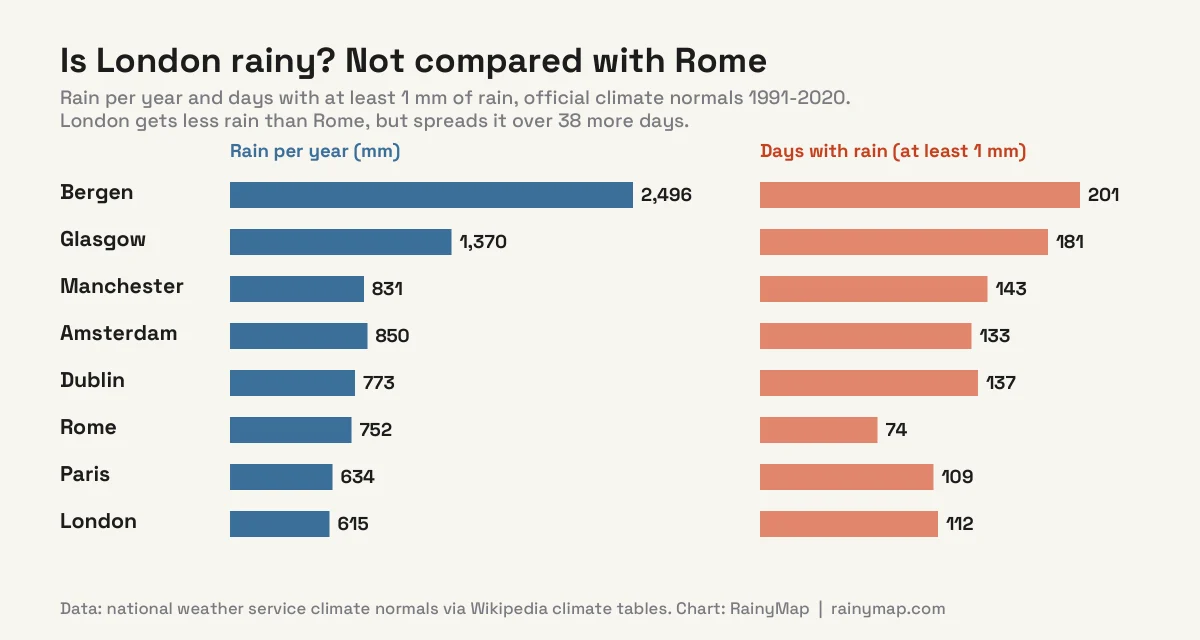
So why does London feel rainy? Because it rains often but lightly. London has about 112 days a year with at least 1 mm of rain, against 74 in Rome. Grey skies, drizzle and short showers add up to a damp reputation without much water. Rome, by contrast, gets most of its rain in a few heavy autumn storms.
The same goes for other “rainy” cities. Amsterdam (850 mm), Dublin (773 mm) and Manchester (831 mm) all sit in the middle of our ranking. Glasgow is the British city that truly earns the reputation, with 1,370 mm and 181 rainy days.

Why Are Some Parts of Europe So Rainy?
Three things explain almost every city near the top of our list:
- The Atlantic. Most of Europe’s weather arrives from the west on the prevailing westerly winds. Cities on the Atlantic coast, from Bergen to Galicia, are the first land these moist air masses reach.
- Mountains. When that air is forced up over high ground, it cools and drops its moisture. That is why Bergen, Glasgow, Lugano and Podgorica, all backed by mountains, get far more rain than flat cities nearby. The far side of the mountains sits in a “rain shadow”: Oslo, east of Norway’s mountains, gets about a third of Bergen’s rain.
- A warm sea in autumn. In October and November the Mediterranean and Adriatic are still warm while cold air starts to arrive from the north. The clash fuels intense storms along the coasts of Italy, Croatia, Montenegro and Albania, which is why Genoa, Rijeka and Podgorica get so much rain on relatively few days.
That timing shows in the data. November was the wettest month in 23 of the 85 cities we compared, and the wettest month fell between October and January in 17 of the top 20. Inland central and eastern Europe is different: in cities like Vienna, Warsaw, Kraków and Riga, summer thunderstorms make June or July the wettest month. Our explainer on what causes thunderstorms covers how those storms form.
Where Is the Wettest Place in Europe?
Not in a city. The wettest place in Europe is generally recognised as Crkvice, a tiny village at about 940 m on Mount Orjen, in the mountains above the Bay of Kotor in Montenegro. A 2012 study in Natural Hazards and Earth System Sciences found an average of 4,593 mm a year there for 1961-1990, with winter the wettest season, and described it as the highest average annual precipitation found in Europe. Other estimates for the Orjen area run to about 5,000 mm. The cause is the same as in Podgorica, only stronger: storms from the Mediterranean, many of them Genoa lows, slam into steep mountains rising straight from the sea.
Other national record holders:
- England: Seathwaite in the Lake District, about 3,552 mm a year, the wettest inhabited place in England according to the Lake District National Park. The UK record for rain in 24 hours, 341.4 mm, fell nearby at Honister Pass on 4-5 December 2015 (Met Office).
- Norway: the national record for a single year is 5,546 mm, measured at Brekke in Gulen, north of Bergen, in 1990.
Which Is the Rainiest Country in Europe?
Averaged over the whole country, Iceland comes first, according to the World Bank’s long-term precipitation data:
- Iceland: 1,940 mm
- Switzerland: 1,537 mm
- Albania: 1,485 mm
- Norway: 1,414 mm
- United Kingdom: 1,220 mm
- Slovenia: 1,162 mm
- Ireland: 1,118 mm
- Croatia: 1,113 mm
- Austria: 1,110 mm
- Bosnia and Herzegovina: 1,028 mm
For comparison, Germany averages about 700 mm and Spain about 636 mm. Montenegro, which would probably rank near the top, has no figure in the dataset. National averages can hide huge differences: the Met Office’s 1991-2020 average for the UK is 1,163 mm, but Scotland gets 1,573 mm and England only 870 mm, because the mountains in the west leave the east in a rain shadow.
How We Built This Ranking
We collected the climate tables for 85 European cities: every capital in our list plus the largest and best-known cities in each region. Each table lists 30-year averages from a national weather service, such as the Norwegian Meteorological Institute, the UK Met Office, Spain’s AEMET or MeteoSwiss, as cited on the city’s Wikipedia page. We checked every table on 15 November 2026.
- One station per city. Rain can vary a lot within a few kilometres, especially near hills, so we used the main station listed for each city. Some are at airports outside the centre; San Sebastián’s figures, for example, come from Hondarribia, 15 km to the east.
- Same period where possible. 80 of the 85 cities use 1991-2020 normals. Galway, Copenhagen and Monaco use 1981-2010, and Dubrovnik and Andorra la Vella use 1971-2000.
- Rainy days only where comparable. Some countries count days with 0.1 mm of rain, others 1 mm. We only compared the 56 cities that use the 1 mm threshold.
The full table of all 85 cities is in our data, and we will refresh it when the next official normals are published.
How to Check the Rain in Any European City Right Now
Averages tell you what to expect over a year. For the next few hours, look at the rain itself.
- Open RainyMap’s rain radar for Europe to see every shower across the continent, updated every few minutes.
- Zoom in on your city, or use the real-time rain map with Use My Location.
- Check the forecast percentage, then read our guide on what a chance of rain really means.
- Planning a trip? Our best time to visit guides show the driest months for popular destinations.
City radar pages include Paris, Munich and Copenhagen.
Frequently Asked Questions
What is the rainiest city in Europe?
Bergen, Norway. Its official 1991-2020 normals show about 2,496 mm of precipitation a year and 201 days with at least 1 mm of rain, both the highest of the 85 European cities we compared. That is about four times as much rain as London.
What is the rainiest capital city in Europe?
Podgorica, the capital of Montenegro, with about 1,693 mm a year (1991-2020). Most of it falls in heavy autumn and winter downpours. Ljubljana (1,368 mm) and Tirana (1,252 mm) follow. If you count rainy days instead, Tórshavn in the Faroe Islands and Reykjavík lead.
Is London the rainiest city in Europe?
No. London gets about 615 mm of rain a year, which ranks it 71st of the 85 cities we compared. Rome (752 mm), Paris (634 mm) and Milan (752 mm) get similar or larger amounts. London’s reputation comes from frequent light rain: it has about 112 days a year with at least 1 mm, against 74 in Rome.
Is Glasgow or Manchester the rainiest city in the UK?
Glasgow is much wetter. Its normals show about 1,370 mm a year and 181 rainy days, against 831 mm and 143 days in Manchester. Among the UK cities we compared, Glasgow ranks first and Cardiff (1,204 mm) second.
Is Rijeka the rainiest city in Europe?
Not quite, but it is close. Rijeka, on Croatia’s Kvarner Gulf, gets about 1,592 mm a year, fifth in our ranking. It rains on far fewer days than in Bergen or Glasgow (about 99 days of 1 mm or more), but when it rains, it pours.
Which European city has the most rainy days?
Bergen, with about 201 days a year with at least 1 mm of rain. Tórshavn in the Faroe Islands (192), Hamburg (188), Munich (182) and Glasgow (181) follow. Hamburg and Munich get much less rain in total, but spread it over many days.
Which European city has the fewest rainy days?
Seville, with about 50 days a year with at least 1 mm of rain, followed by Barcelona (53), Marseille (54) and Madrid (59). Madrid is also the driest capital we checked, at 416 mm a year.
What month does it rain the most in Europe?
For most of the continent, November. It was the wettest month in 23 of the 85 cities we compared, and in 17 of the 20 rainiest cities the wettest month falls between October and January. Inland central and eastern Europe is the exception: there, summer thunderstorms make June or July the wettest month.
Where is the wettest place in Europe?
Crkvice, a small village on Mount Orjen above the Bay of Kotor in Montenegro. A study in the journal Natural Hazards and Earth System Sciences found an average of 4,593 mm a year there for 1961-1990 and called it the highest average annual precipitation found in Europe. Other estimates for the area run to about 5,000 mm.
Which is the rainiest country in Europe?
Iceland, by average rainfall across the whole country: about 1,940 mm a year in the World Bank’s long-term data. Switzerland (1,537 mm), Albania (1,485 mm) and Norway (1,414 mm) follow. Mountains and Atlantic or Mediterranean moisture are what these countries have in common.
Sources
Data checked on 15 November 2026. City figures are official climate normals (mostly 1991-2020) from national weather services, as published in each city’s Wikipedia climate table; the rankings, charts and analysis are RainyMap’s own.
- City of Bergen: Climate figures for Bergen (MET Norway data, Florida station)
- Met Office: Heathrow (London) climate averages 1991-2020
- Met Office: Bishopton (Glasgow) climate averages 1991-2020
- Met Office: How much does it rain in the UK?
- Ducić et al. (2012), precipitation extremes in the wettest Mediterranean region (Krivošije) and associated atmospheric circulation types. Natural Hazards and Earth System Sciences 12
- Lake District National Park: Facts and figures
- Store norske leksikon: Brekke (Gulen)
- World Bank: Average precipitation in depth (mm per year)
- Meze-Hausken (2007), International Journal of Biometeorology: a study that describes Bergen as Europe’s rainiest city
Featured image: a turquoise umbrella in the rain in front of Big Ben, London, January 2017. Photo: Heidi Sandstrom / Wikimedia Commons (CC0).