Last updated: July 13, 2026.
Quick Answer
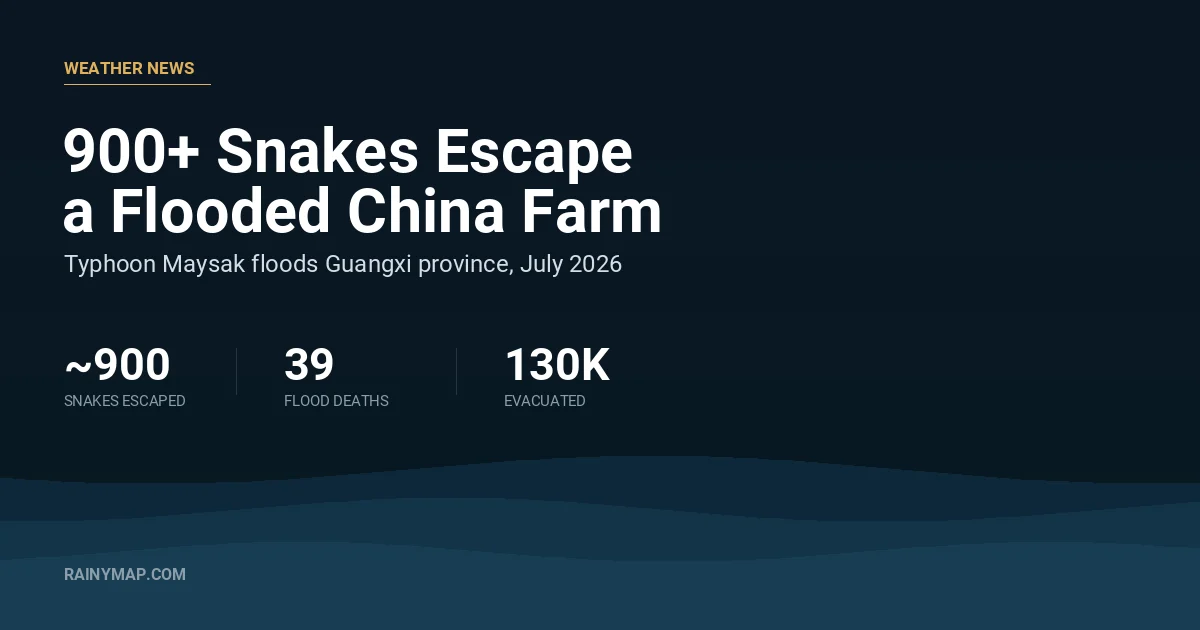
Torrential rain from Typhoon Maysak breached two reservoirs above Hengzhou, a city in China’s Guangxi region, on the morning of July 6, 2026. The floodwater washed away a commercial snake-breeding farm in nearby Dengwei village, releasing an estimated 900 snakes — including venomous cobras, along with king ratsnakes and non-venomous water snakes — into the flooded streets. At least one person has died from a suspected cobra bite and several others have been bitten. Civilian snake-catching teams have since captured thousands of animals, though most of those caught have been the non-venomous water snakes. The farm escape is one consequence of flooding that has killed 39 people and forced roughly 130,000 evacuations across Guangxi.
What Happened at the Hengzhou Snake Farm
Days of extreme rainfall from Typhoon Maysak overwhelmed the Liulan and Yunbiao reservoirs above Hengzhou, and both breached their walls on the morning of Monday, July 6. The resulting flash flood tore through Dengwei village and inundated a commercial snake farm, destroying the enclosures that held the animals inside.
By Tuesday, July 7, residents were posting videos and photos online showing snakes swimming through the floodwater between houses, warning neighbors to stay alert. Local reports put the number of escaped snakes at around 900, a mix of venomous cobras and two non-venomous species, king ratsnakes and water snakes, that are commonly farmed in the region side by side.
Why China Farms Cobras in the First Place
Commercial snake farming is a long-established, legal industry in parts of southern China, including Guangxi. Farms in the region breed cobras and related species for three main markets: traditional Chinese medicine, snake meat for food, and venom used in antivenom production. Guangxi’s warm, humid climate and rural land availability have made it a hub for this kind of livestock farming — which is exactly why a single flooded facility could release so many animals at once.
The Human Toll
At least one woman has died after being bitten by a snake suspected to be a cobra that had escaped one of the flooded farms in the area. State media has reported several additional snakebite cases at local hospitals since the flooding began. The bites add a dangerous complication for residents already dealing with the flood itself — wading through murky, debris-filled water is exactly the kind of situation where a snake, venomous or not, is easy to step on without seeing it.
This local tragedy sits inside a much larger disaster. Flooding tied to Typhoon Maysak has killed 39 people across Guangxi, including 26 deaths linked to a separate dam breach that inundated the city of Nanning. Roughly 130,000 residents have been evacuated from affected areas, and authorities have deployed some 5,700 boats and drone teams to deliver supplies and pull trapped residents to safety.
How Villagers Are Catching the Snakes
With official resources stretched thin by the broader flood response, more than a dozen residents from nearby villages formed a civilian snake-catching team, working house to house through affected areas with fishing tools and electric fishing equipment to net the animals. One team member described a group of seven or eight people working continuously for two days.
Across the wider flood zone, catchers report having captured between 2,000 and 3,000 snakes in total — a number that spans multiple farms and species, not just the roughly 900 that escaped the one facility in Dengwei. Encouragingly, most of what’s been caught so far has been the non-venomous water snake variety rather than cobras, though the search continues.
Not Just Snakes: A Zoo Lost Animals Too
The snake farm wasn’t the only facility breached by Guangxi’s floodwater. At Guigang Zoo, also in the province, at least 100 animals escaped after the flooding damaged their enclosures — including alpacas, miniature pigs, and zebras. It’s a reminder of how quickly a major flood can turn from a water and infrastructure crisis into an animal-control one, whether the animals involved are farm livestock, exotic zoo species, or, in this case, cobras.
The Storm Behind It All: Typhoon Maysak
Typhoon Maysak was the first typhoon of China’s 2026 season, and it dropped days of extreme, sustained rainfall over Guangxi before the reservoirs above Hengzhou gave way. The same system has been linked to flash flooding and rare tornado activity hundreds of kilometers away, part of a broader pattern of intense, fast-moving storm systems this season. For the latest on how this year’s tropical activity compares to prior seasons, see our coverage of the 2026 Atlantic hurricane season and our tracker on whether 2026 will be the hottest year on record, since warmer ocean water is one of the key ingredients behind storms capable of dumping this much rain this fast.
If you want to track rainfall building over a region in real time rather than after the fact, our live rain radar and 7-day forecast both update continuously and are free to use.
How Dangerous Are Cobras, and What Should You Do If You See One?
Cobra venom is primarily neurotoxic: a bite can cause swelling and tissue damage at the site, followed by drowsiness, muscle weakness, and in serious untreated cases, paralysis affecting breathing. It is a medical emergency every time, not just when symptoms look severe at first.
- Get to a hospital immediately. Antivenom is time-sensitive and most effective early.
- Keep the bitten limb still and roughly at heart level; movement speeds venom spreading through the body.
- Do not apply a tourniquet, cut the wound, try to suck out venom, or apply ice — all of these are now known to make outcomes worse, not better, according to the World Health Organization and the Red Cross.
- If it’s safe to do so from a distance, note the snake’s color and shape for hospital staff — it can help them select the right antivenom — but never attempt to catch or kill it yourself.
- In a flood zone specifically, assume any murky water may be hiding a snake and avoid wading through it barefoot or in the dark.
Frequently Asked Questions
How many cobras escaped the China snake farm?
Around 900 snakes in total escaped the flooded farm in Dengwei village, Hengzhou. That figure includes venomous cobras alongside non-venomous king ratsnakes and water snakes, which are farmed together at the same facility.
Has anyone died from the escaped snakes?
Yes. At least one woman has died after being bitten by a snake suspected to be a cobra that escaped during the flooding, and several other people have been treated for snakebites at local hospitals.
Why does China farm cobras?
Cobras and related snake species are farmed commercially in parts of southern China, including Guangxi, for traditional medicine, snake meat, and venom used in antivenom production. It’s a legal, long-established regional industry.
What caused the flooding that freed the snakes?
Typhoon Maysak, the first typhoon of China’s 2026 season, dropped days of torrential rain over Guangxi. Two reservoirs, Liulan and Yunbiao, breached their walls on July 6, sending a flash flood through Dengwei village that destroyed the snake farm’s enclosures.
Have most of the escaped snakes been recaptured?
Civilian snake-catching teams have captured an estimated 2,000–3,000 snakes across the wider flood zone (spanning multiple farms), and report that most of what they’ve caught so far has been non-venomous water snakes rather than cobras. The full recapture effort was still ongoing as of this writing.
What should I do if I’m bitten by a cobra?
Get to a hospital immediately, keep the bitten limb still, and avoid tourniquets, ice, cutting, or suction — these outdated first-aid methods can make outcomes worse. See the safety section above for full guidance from the WHO and Red Cross.
Sources
- CNN — Torrential rains bring devastating floods to a Chinese city — and a snake invasion
- Global Times — Around 900 snakes, including venomous cobras, escape flood-damaged farm in Guangxi
- Al Jazeera — Flooding from Tropical Storm Maysak kills 39 in southern China
- Discover Wildlife — 900 snakes on the loose, swimming through floodwaters in South China
- World Health Organization — Snakebite envenoming treatment guidance
- American Red Cross — Venomous snake bite first aid