
Clouds are the sky’s way of telling you what’s coming next, and once you know the basic categories, you can often predict weather changes hours before they arrive.
The Three Height Families
Meteorologists classify clouds primarily by altitude: high clouds (above roughly 20,000 ft), mid-level clouds (6,500-20,000 ft), and low clouds (below 6,500 ft), plus clouds with strong vertical growth that span multiple levels.
High Clouds
- Cirrus: Thin, wispy streaks made of ice crystals. Often the first sign of an approaching warm front, meaning rain may follow within a day or two.
- Cirrostratus: A thin, milky veil that can produce a halo around the sun or moon, another warm-front indicator.
- Cirrocumulus: Small, white patches arranged in rows, sometimes called a “mackerel sky.”
Mid-Level Clouds
- Altocumulus: Gray-white patches or rolls, can signal thunderstorm development later in the day if seen on a humid morning.
- Altostratus: A gray or blue-gray sheet that often covers the whole sky ahead of steady rain or snow.
Low Clouds
- Stratus: A flat, featureless gray layer, associated with drizzle or light, steady precipitation.
- Stratocumulus: Lumpy, rounded patches in a layer, usually not producing much rain.
- Nimbostratus: A thick, dark layer that produces continuous, often prolonged rain or snow.
Vertical Development Clouds
- Cumulus: Puffy, cotton-like clouds with flat bases, common on fair-weather days.
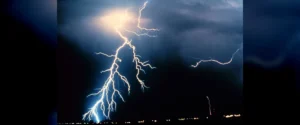
- Cumulonimbus: Towering storm clouds capable of producing heavy rain, hail, and lightning, the type responsible for thunderstorms, as explained in what causes thunderstorms.
From Sky-Watching to Live Data
Looking up can tell you a storm might be coming, but pairing that with a live rain map and lightning map confirms exactly when and where it’s actually happening.
The Three Height Levels
Cloud classification is built on altitude first, shape second. Learning the three levels makes every cloud name afterwards easier to remember.
- High clouds (above roughly 6,000 m) carry the prefix cirro- and are composed of ice crystals. Cirrus, cirrostratus and cirrocumulus.
- Mid-level clouds (2,000–6,000 m) carry alto-. Altostratus and altocumulus.
- Low clouds (below 2,000 m) have no prefix. Stratus, stratocumulus and nimbostratus.
Two words describe form rather than height: stratus means a flat layer, cumulus a heaped pile. Nimbus means precipitating. So nimbostratus is a raining layer cloud, and cumulonimbus a raining heap — a thunderstorm.
Clouds That Tell You Rain Is Coming
A warm front arrives with a recognisable sequence over roughly a day, and spotting it early is genuinely useful.
First cirrus appears, thin and wispy, often with hooked ends. It thickens into cirrostratus, a milky veil that frequently produces a halo around the sun or moon — a reliable old indicator of approaching rain. That lowers and thickens into altostratus, through which the sun looks as though seen through frosted glass. Finally nimbostratus arrives, grey and featureless, and steady rain begins.
The whole sequence typically unfolds over 12 to 24 hours, which is why a halo often means rain within a day.
Clouds That Mean Storms
Cumulonimbus is the one that matters. It grows from ordinary fair-weather cumulus when instability is sufficient, rising until it hits the stable layer at the top of the troposphere and spreads sideways into a flat anvil.
The anvil is the tell. A cumulus cloud with a crisp cauliflower top is still growing. Once the top glaciates into a fibrous anvil, the storm is mature and producing lightning and heavy rain. If you can see an anvil, the storm beneath it is already active.
Frequently Asked Questions
What are the main cloud types?
Clouds are classified by altitude and form. High clouds use the prefix cirro-, mid-level clouds alto-, and low clouds no prefix. Stratus means a flat layer, cumulus a heaped pile, and nimbus indicates precipitation.
Which clouds mean rain is coming?
A thickening sequence from cirrus to cirrostratus to altostratus to nimbostratus signals an approaching warm front, usually bringing steady rain within 12 to 24 hours. A halo around the sun or moon, caused by cirrostratus, is a classic early indicator.
What cloud produces thunderstorms?
Cumulonimbus. It grows from fair-weather cumulus when the atmosphere is unstable, rising until it reaches the stable layer at the top of the troposphere and spreading sideways into a flat anvil shape.
What does an anvil cloud mean?
That a thunderstorm has reached maturity. The anvil forms where the rising column hits the stable layer aloft and spreads horizontally. A visible anvil means the storm beneath it is already producing lightning and heavy rain.
What does a halo around the sun or moon mean?
It is caused by light refracting through ice crystals in cirrostratus cloud, which typically precedes a warm front. It is a genuinely reliable sign that rain may arrive within about a day.
In Conclusion
Learning to identify just these ten cloud types turns a glance at the sky into a genuine short-term forecast, no app required, though checking one certainly doesn’t hurt.