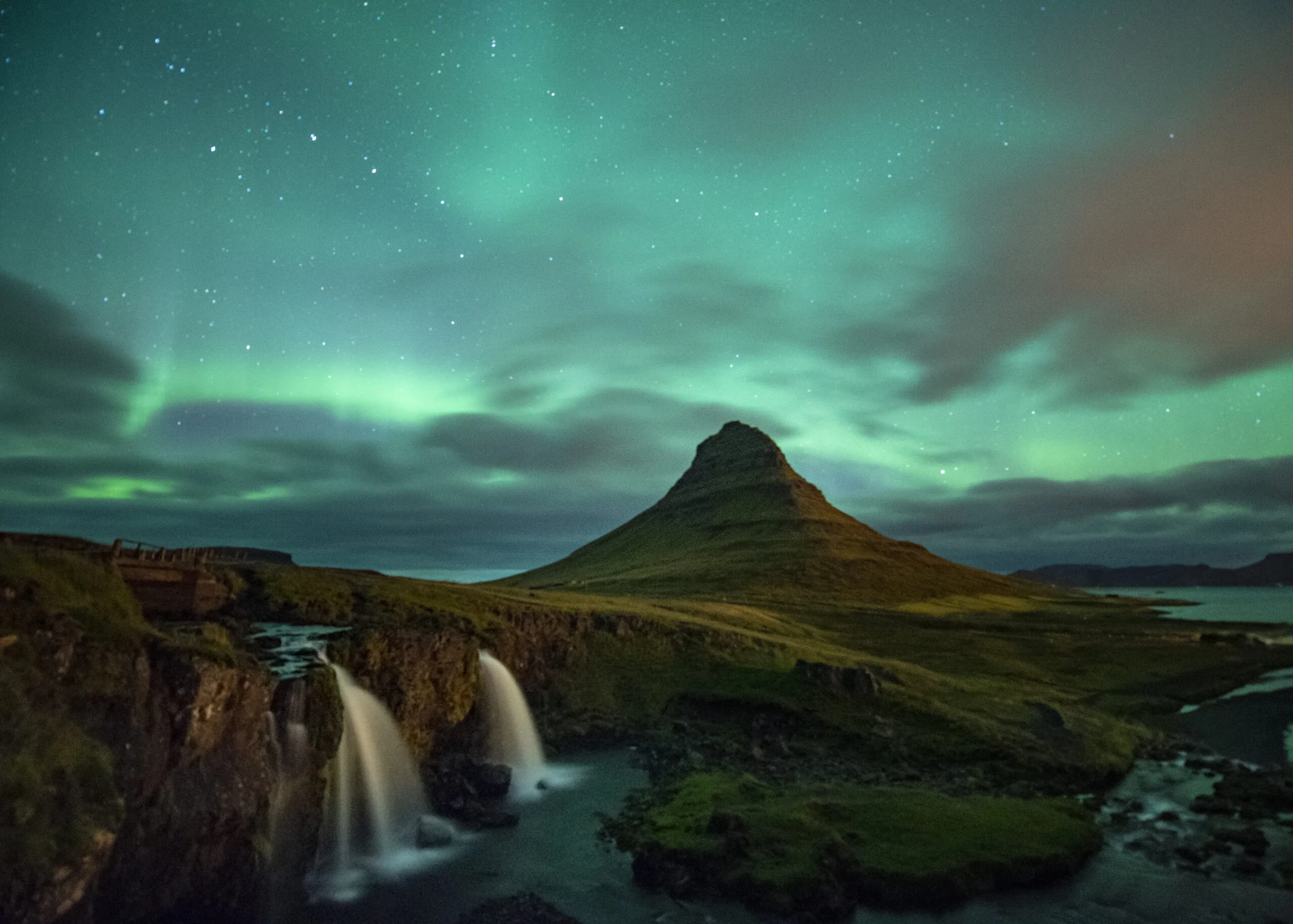
The best time to visit Iceland depends entirely on what you are chasing: winter, roughly September through March, is best for the Northern Lights, while summer, June through August, offers nearly 24-hour daylight, milder temperatures, and access to highland roads closed the rest of the year.
Iceland’s Climate: Cool, Wet, and Milder Than You’d Expect
Despite its name and latitude, Iceland’s coastal climate, warmed by the Gulf Stream, keeps temperatures far milder than places at similar latitude in North America or Siberia. Rain and showers are a near-constant year-round companion rather than a seasonal event, and the single biggest variable across the year is not temperature but daylight: from roughly 4-5 hours in December to nearly 21 hours in June.
Weather by Month
The chart below shows average high and low temperatures, monthly rainfall, and average daylight hours for every month, based on long-term climate normals.
Jan
(36°/28°F)
20 rainy days
Daylight 5h
Feb
(37°/28°F)
18 rainy days
Daylight 8h
Mar
(39°/30°F)
19 rainy days
Daylight 11h
Apr
(45°/34°F)
15 rainy days
Daylight 14h
May
(52°/39°F)
13 rainy days
Daylight 18h
Jun
(55°/45°F)
12 rainy days
Daylight 21h
Jul
(59°/48°F)
13 rainy days
Daylight 19h
Aug
(57°/48°F)
14 rainy days
Daylight 16h
Sep
(54°/43°F)
16 rainy days
Daylight 12h
Oct
(46°/37°F)
18 rainy days
Daylight 9h
Nov
(41°/32°F)
19 rainy days
Daylight 6h
Dec
(37°/30°F)
20 rainy days
Daylight 4h
| Month | Avg. High | Avg. Low | Rainfall | Rainy Days | Daylight |
|---|---|---|---|---|---|
| Jan | 2°C / 36°F | -2°C / 28°F | 80 mm | 20 | 5h |
| Feb | 3°C / 37°F | -2°C / 28°F | 70 mm | 18 | 8h |
| Mar | 4°C / 39°F | -1°C / 30°F | 75 mm | 19 | 11h |
| Apr | 7°C / 45°F | 1°C / 34°F | 55 mm | 15 | 14h |
| May | 11°C / 52°F | 4°C / 39°F | 45 mm | 13 | 18h |
| Jun | 13°C / 55°F | 7°C / 45°F | 45 mm | 12 | 21h |
| Jul | 15°C / 59°F | 9°C / 48°F | 50 mm | 13 | 19h |
| Aug | 14°C / 57°F | 9°C / 48°F | 60 mm | 14 | 16h |
| Sep | 12°C / 54°F | 6°C / 43°F | 70 mm | 16 | 12h |
| Oct | 8°C / 46°F | 3°C / 37°F | 85 mm | 18 | 9h |
| Nov | 5°C / 41°F | 0°C / 32°F | 80 mm | 19 | 6h |
| Dec | 3°C / 37°F | -1°C / 30°F | 80 mm | 20 | 4h |
Summer (June-August): Long Days and Full Access
Iceland’s summer brings the midnight sun, with daylight stretching nearly around the clock in June and July, giving travelers extra hours to explore. Temperatures are the mildest of the year, typically in the low-to-mid teens Celsius (50s-60s Fahrenheit), and this is the only period when many highland (F-road) routes are open, since they remain snow-covered or impassable the rest of the year.
Winter (September-March): Chasing the Northern Lights
Aurora sightings require dark skies, which is why the Northern Lights are only visible roughly from late August through mid-April, with the darkest, longest nights between November and February offering the most viewing opportunities, weather permitting. Clear, cold nights away from city lights give the best odds, though Iceland’s changeable weather means multiple nights of trying is often necessary.
Shoulder Seasons: May and September
May and September split the difference, offering milder crowds and prices than peak summer, decent daylight hours, and in September, an early chance at aurora sightings as nights start lengthening again. Road conditions are more variable than summer but generally still manageable on the main Ring Road.
Iceland’s Weather Can Change Fast
Icelandic weather is famously changeable, sometimes shifting from clear skies to wind and rain within the same afternoon. A live rain map paired with a real-time wind map is genuinely useful here, since strong, sudden wind gusts affect driving conditions and outdoor plans as much as rainfall does. The live rain radar for Reykjavik is a good starting point for the capital region.
Frequently Asked Questions
What is the best month to see the Northern Lights in Iceland?
November through February offers the longest, darkest nights and the best odds, though the aurora is technically visible any clear night from late August through mid-April.
What is the best month to visit Iceland for the midnight sun?
June offers the most daylight, around 21 hours, with the sun barely dipping below the horizon around the summer solstice.
What is the coldest month in Iceland?
January and December are the coldest, with average highs around 2-3C (36-37F) and lows dropping to around -2C (28F), though Iceland’s coastal climate keeps it milder than its latitude suggests.
Is Iceland rainy all year?
Yes, precipitation is fairly consistent year-round, ranging from about 45mm in late spring to around 85mm in October, though it often falls as brief showers rather than sustained rain.
Do I need a 4×4 to drive in Iceland?
For the main Ring Road in summer, a 4×4 is not required, but winter driving and any highland F-roads, only open in summer, do require one due to snow, ice, and unpaved river crossings.
What is the cheapest month to visit Iceland?
November and early December, outside the Christmas period, along with January and February, typically offer the lowest flight and hotel prices, alongside the best aurora viewing conditions.
In Conclusion
Choose winter for aurora hunting under long, dark nights, or summer for road-trip-friendly weather and endless daylight. Whichever season you pick, Iceland rewards travelers who check conditions frequently rather than trusting a single forecast.