Lightning is one of nature’s most dramatic displays, but at its core it’s a simple physics problem: how does a storm build up enough electrical charge to arc through the sky or strike the ground?
Building an Electrical Charge
Inside a thunderstorm, powerful updrafts and downdrafts send ice crystals, graupel (soft hail), and water droplets crashing into each other at high speed. These collisions strip electrons from some particles and deposit them on others, a process similar to rubbing a balloon on your hair. Lighter, positively charged ice crystals get carried to the top of the cloud, while heavier, negatively charged particles sink toward the base.
The Cloud Becomes a Giant Capacitor
This separation of charge turns the storm cloud into something like a giant battery, negative charge concentrated near the base, positive charge near the top, and often a positive charge induced on the ground below. Once the voltage difference becomes large enough to overcome the insulating properties of air, a discharge occurs, that discharge is lightning.
Types of Lightning
- Cloud-to-ground: The most damaging type, a channel of charge travels from cloud to earth, often striking the tallest object in the area.
- Intra-cloud: Discharges that occur entirely within a single cloud, the most common type overall.
- Cloud-to-cloud: Lightning that jumps between separate storm clouds.
Why Thunder Follows Lightning
A lightning channel superheats the surrounding air to roughly five times the surface temperature of the sun in a fraction of a second. That air expands explosively, creating the shockwave we hear as thunder. Because light travels far faster than sound, counting the seconds between the flash and the boom (roughly 5 seconds per mile) gives a rough distance estimate.
Tracking Lightning in Real Time
Modern detection networks pick up the electromagnetic pulse each strike emits, which is how our real-time lightning map can plot strikes within seconds of them happening, often alongside the rain map showing the parent storm cell.
How the Charge Separates
Lightning requires an enormous voltage difference, and building one inside a cloud depends on collisions.
In a storm’s updraught, small ice crystals are carried upward while larger soft hail pellets, called graupel, fall downward. Where they collide in the presence of supercooled water, charge transfers between them. The lighter ice crystals tend to acquire positive charge and continue rising; the heavier graupel acquires negative charge and sinks.
The result is a separated cloud: positive charge accumulating near the top, negative near the base. Vertical motion is essential — without a strong updraught to keep particles colliding and sorting, no significant charge builds. This is why lightning accompanies vigorous convection rather than steady rain.
The Stepped Leader and Return Stroke
Air is an excellent insulator, so charge builds until the difference becomes overwhelming — typically tens of millions of volts.
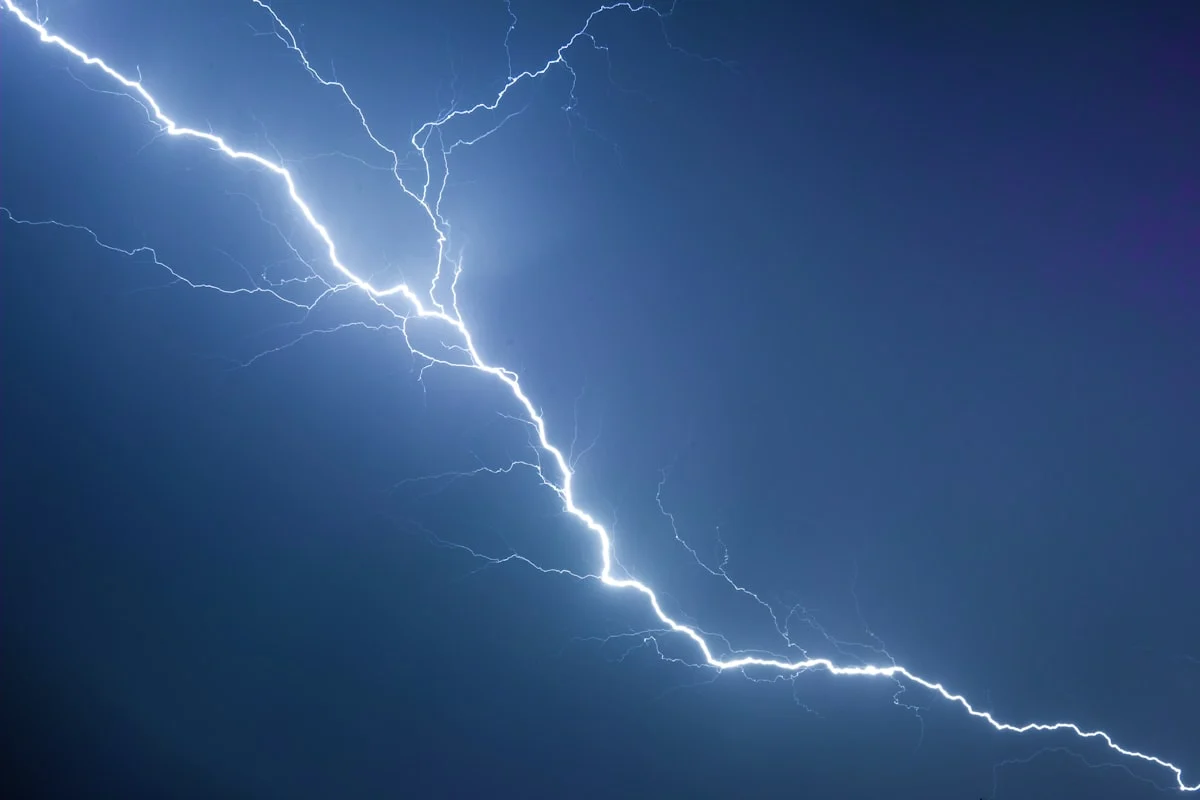
Then a faint channel of ionised air called a stepped leader begins working downward from the cloud in rapid jumps, branching as it searches for a path. As it nears the surface, upward streamers rise from tall objects to meet it. When one connects, a complete conducting channel exists between cloud and ground.
The return stroke then surges upward through that channel at roughly a third of the speed of light, and this is the brilliant flash you actually see. The visible bolt travels upward, not downward, despite appearances. Flickering happens when several strokes follow the same channel in quick succession.
Where Thunder Comes From
The channel reaches around 30,000 kelvin, roughly five times the surface temperature of the Sun. Air surrounding it expands explosively, creating a shock wave that decays into the sound we hear. Nearby strikes produce a sharp crack because the shock arrives with little distortion. Distant ones rumble because sound from different parts of the channel arrives at different times and is refracted along the way.
Frequently Asked Questions
How does lightning form?
Colliding ice crystals and graupel inside a storm’s updraught transfer charge, with lighter positively charged crystals carried upward and heavier negatively charged graupel sinking. This separates charge within the cloud until the voltage difference becomes large enough to break down the insulating air.
Does lightning travel up or down?
Both. A faint stepped leader works downward from the cloud, but the brilliant flash you see is the return stroke surging upward through that channel at about a third of the speed of light.
How hot is lightning?
The channel reaches roughly 30,000 kelvin, around five times hotter than the surface of the Sun. The explosive expansion of air around it creates the shock wave heard as thunder.
Why does thunder rumble instead of cracking?
Distance. A nearby strike produces a sharp crack because the shock wave arrives largely intact. From further away, sound from different parts of the long lightning channel arrives at slightly different times and is refracted by the atmosphere, stretching the sound into a rumble.
Why does lightning only happen in some storms?
Because charge separation requires a strong updraught to keep ice particles colliding and sorting by weight. Steady stratiform rain lacks the vertical motion needed, which is why it rains without lightning.
Can lightning strike without rain reaching the ground?
Yes. In dry thunderstorms the rain evaporates before landing while the storm remains electrically active. These are a significant wildfire ignition risk.
In Conclusion
Lightning is the visible release of an invisible buildup, charge separated by violent collisions inside a storm, discharged the moment the surrounding air can no longer hold it back.